Key takeaways
- Pro: Four-thousand-level pressure with Wacom’s mature driver ecosystem
- Pro: Bluetooth eliminates the primary desk-management complaint of the wired version
- Con: Eight-by-six-inch active area can feel cramped for broad strokes
What's inside
A creative buyer shopping for the best tablets for creatives faces a category that lumps together fundamentally different tools: pen tablets without screens, display tablets with built-in monitors, paper notebooks with the word “tablet” in their names, and general-purpose Android devices marketed as drawing companions. The confusion is understandable, and the wrong pick leads to frustration within days of unboxing.
These eight products span from under seven dollars to nearly six hundred fifty, and that gap reflects real differences in build quality, stylus precision, and whether you get a screen to draw directly on. What separates a worthwhile purchase from a regret is honest self-assessment: do you need a display, how much desk space you have, what software you already own, and whether you will actually use the features you pay for. The comparison below examines published specs and recurring owner feedback for each product.
As an Amazon Associate we earn from qualifying purchases at no extra cost to you. Product prices and availability are accurate as of the date shown and are subject to change.



Quick Picks
| Product | Best For | Price |
|---|---|---|
| Wacom Intuos Small (Bluetooth) | Cable-free desktop drawing | $69.95 |
| Wacom Intuos Small (Wired) | Lowest-cost entry into pen tablets | $39.95 |
| Mead Primary Journal (10297) | Early-literacy paper writing for K-2 | $6.74 |
| TCL NXTPAPER 11 Gen 2 | Matte-screen note-taking and light sketching | $229.99 |
| Primary Journal Creative Story Tablet | Bulk classroom or home writing paper | $6.95 |
| XPPen Deco 01 V3 | Large active area on a budget | $44.00 |
| HUION Kamvas 13 Gen 3 | Display-tablet value with dual dials | $229.00 |
| Wacom Cintiq 16 | Professional illustration with a QHD canvas | $649.95 |
How We Picked
Four criteria drive every recommendation in this roundup. The first is input quality: pen pressure levels, tilt support, and whether the stylus requires charging. The second is workflow fit, because a product designed for illustrators serves a different person than one suited to students or note-takers. The third is software compatibility, since a tablet that fights your existing programs costs you time. The fourth is long-term durability reported by owners who have used the product well beyond the return window.
The 8 Best Tablets For Creatives in 2026
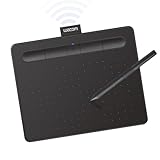
Wacom Intuos Small, Bluetooth
The Bluetooth Intuos Small targets artists who want Wacom’s proven pen technology without tethering to a desk. Owners consistently praise the four-thousand-pressure-level stylus and the included software bundle, which typically covers Clip Studio Paint or MediBang depending on promotion. The wireless link removes cable clutter from a small workspace, a detail that matters more in daily use than it sounds on a spec sheet.
- Pro: Four-thousand-level pressure with Wacom’s mature driver ecosystem
- Pro: Bluetooth eliminates the primary desk-management complaint of the wired version
- Con: Eight-by-six-inch active area can feel cramped for broad strokes
Skip this if your style relies on full-arm gestures or if you already have a wired setup and only want Bluetooth convenience, since the wired model costs half as much with no meaningful precision difference.
Wacom Intuos Small, Wired
At under forty dollars, this is the entry point that makes pen-input drawing accessible without a compromise in stylus quality. It shares the same pressure levels and pen design as its Bluetooth sibling, and long-term owners report that the cable eliminates battery anxiety entirely—a practical advantage during focused sessions.
- Pro: Identical pen technology to the Bluetooth model at half the price
- Pro: No charging, no pairing issues, no firmware-update gaps
- Con: Cord limits placement and can snag during fast work
Skip it if you draw at a standing desk, travel frequently with your setup, or already have enough cable clutter. For seated fixed-station use, it delivers Wacom’s core drawing experience at a price that makes paying more hard to justify.
Mead Primary Journal (10297)
This is a paper composition notebook, and the word “tablet” in its name reflects an older educational convention rather than any digital capability. It serves a specific real need: young students in grades K through 2 who require a durable lined writing surface for early literacy exercises. The one-hundred-sheet count and compact format fit easily in small backpacks. Owner feedback highlights the sturdy covers surviving a full school year in a child’s bag.
- Pro: Extremely low price for a classroom-quantity paper supply
- Pro: Sized appropriately for small hands developing grip control
- Con: Contains no electronic components or digital functionality
Skip this entirely if you are looking for a digital device—it has no screen, no stylus, and no connectivity. It is a budget stationery purchase, not a tablet in the technology sense.
TCL NXTPAPER 11 Gen 2
The NXTPAPER 11 Gen 2 occupies a middle ground between a general-purpose tablet and a dedicated art tool. Its eleven-inch paper-like display reduces glare and produces a surface texture that casual sketchers find more natural than bare glass, while the eight-gigabyte RAM and one-hundred-twenty-eight-gigabyte storage handle note apps and light illustration without slowdown.
- Pro: Matte screen feels close to drawing on paper for handwriting and rough sketches
- Pro: Full Android functionality doubles as an e-reader and media tablet
- Con: Pressure sensitivity behavior varies by app; not suited for professional art software
Skip it if you need reliable pressure curves in Photoshop or Clip Studio Paint. It works best as a reading, note-taking, and light-sketching companion rather than a serious illustration surface.
Primary Journal Creative Story Tablet (Green Marble)
Like the Mead notebook above, this product is a paper writing journal marketed with the word “tablet” for its bound, portable form factor. At seventy-five sheets in a large eight-and-a-half-by-eleven-inch format, it suits older students or adults who prefer wide paper for sketches, journaling, or handwriting exercises. Owners buy these in bulk for classrooms and home study.
- Pro: Generous page count and large format for a price under seven dollars
- Pro: Durable cover suitable for repeated transport in a bag
- Con: No digital components; the name is purely traditional
Skip this if you expect any electronic functionality. It is a large writing surface at a commodity price, which is its only claim to this category.
XPPen Deco 01 V3
The Deco 01 V3 gives a ten-by-six-inch active area—noticeably larger than the Wacom Intuos Small—at a price close to the wired Wacom. The sixteen-thousand-pressure-level battery-free stylus is a genuine step up in theoretical resolution, and the eight programmable keys reduce menu navigation during long sessions. Owner feedback frequently mentions the included XPPen software as a capable alternative to paid suites.
- Pro: Largest active area per dollar among the non-display tablets here
- Pro: Battery-free stylus with sixteen-thousand levels and eight shortcut keys
- Con: Driver support for niche software is less battle-tested than Wacom’s
Skip it if you work in a software environment where Wacom drivers are the only well-documented path; otherwise it offers strong value per square inch of drawing area.
HUION Kamvas 13 Gen 3
The Kamvas 13 Gen 3 brings a 13.3-inch laminated display with dual physical dials into a price bracket that would not have existed for a screen tablet of this size even recently. Owners highlight the dual dial as a workflow accelerator for brush size and zoom, and the Gen 3 panel improves color reproduction over the prior version. The con is bulk: it demands desk space and does not fold into a laptop-lid profile, so portability is limited.
- Pro: Dual physical dials reduce keyboard shortcuts during painting sessions
- Pro: 13.3-inch QHD-class panel at roughly a third of the Cintiq 16 price
- Con: Fixed-desk form factor with no laptop-style portability
Skip it if you travel between studios regularly. For fixed-desk illustration, it delivers a near-Cintiq experience at a fraction of the cost.
Wacom Cintiq 16
The Cintiq 16 remains the reference display tablet for professionals who need Wacom’s driver infrastructure, QHD resolution, and the Pro Pen 3 in a larger canvas. The sixteen-inch screen gives visible detail when inking or working on tight illustration, and the Pro Pen 3’s tilt and low activation force are features experienced users notice within the first hour. Owner feedback treats it as a tool that fades into the background of work.
- Pro: Pro Pen 3 with industry-leading driver compatibility across creative software
- Pro: QHD sixteen-inch panel provides accurate color for professional output
- Con: Requires dedicated desk real estate and a professional-workload budget
Skip it if you are exploring digital drawing as a hobby. For full-time illustrators in 2026, it remains a safe long-term investment.
Buying Guide
Screen or No Screen
Display tablets let you draw directly on the surface you see, which shortens the learning curve and produces more intuitive line control. Pen tablets without screens require you to look up at a monitor while your hand moves on a separate pad—a skill that takes weeks to build but eliminates the need for a second large desk surface. The decision is about workspace and patience, not about which produces better art. If you have limited desk space, a non-screen tablet paired with a monitor you already own is the more practical architecture.
Stylus Pressure and Tilt
Published pressure levels measure the maximum number of distinct force increments a pen can register. In practice, owner feedback suggests that beyond roughly two thousand levels the perceptual difference diminishes, but higher counts benefit from smoother ramp curves in supported software. Tilt support matters for natural-media simulation: if you draw with charcoal or brush tools, a stylus that reports angle lets the software vary stroke width and opacity the way a physical pencil would.
Software Compatibility Before You Buy
Check the manufacturer’s driver page against the exact version of the art software you use before purchasing. Wacom has the broadest compatibility because studios standardized on its hardware over many years. XPPen and HUION drivers work well in mainstream programs but occasionally lag on updates for niche applications. The TCL NXTPAPER relies on Android-level pen input, which means each drawing app must explicitly support stylus APIs—a situation where owner forum threads are more useful than any spec sheet.
Our Verdict
The Wacom Cintiq 16 is the top pick for anyone who draws as a primary creative practice: its display size, pen quality, and driver reliability reduce friction between intent and output. The budget pick is the wired Wacom Intuos Small at under forty dollars, which delivers the same pen technology as the Bluetooth version for half the price and is the least-risk way to confirm whether digital drawing suits you. The condition that changes the ranking: if your workspace is small or you need a portable device for travel, the HUION Kamvas 13 Gen 3 wins on size-per-dollar.
FAQ
Do these pen tablets work with iPads?
No. The Wacom, XPPen, and HUION models connect to computers via USB or Bluetooth and require desktop drivers. They do not function as peripherals for iPads or other tablets running mobile operating systems without a specific host app, which is a rare exception rather than the rule.
Is a paper notebook ever the right answer here?
For young children building fine-motor skills or for quick sketching without power, a paper product like the Mead or Primary Journal notebooks is genuinely appropriate. They do not compete with digital tablets for illustration work but serve a different creative stage.
Do I need a stand for a display tablet?
HUION and Wacom display tablets typically include a basic angled stand in the box. Owner feedback suggests that a dedicated adjustable arm improves ergonomics during long sessions, but it is not a strict requirement to begin working.
What is the real difference between a $40 pen tablet and a $650 display tablet?
Screen size, color accuracy, and software ecosystem depth. A non-screen tablet gives you the pen; a display tablet gives you the pen on a calibrated surface you draw directly upon. The price difference buys workflow efficiency and desk real estate, not fundamentally different drawing ability.