Key takeaways
- Pro: Highest filtration efficiency on this list at the lowest per-unit cost among MERV 11 options.
- Pro: Actual size of 19.75 x 19.75 x 0.75 inches fits snugly in most standard 20×20 slots with minimal bypass.
- Con: Only available in 20×20; not a fit if your system uses a different nominal size.
What's inside
A clogged air conditioner filter is the most common cause of reduced cooling performance in central systems. When dust, lint, and pet dander accumulate on the pleats, airflow drops, the compressor works harder, and energy costs climb. The right filter catches airborne particles before they reach the coil, but choosing poorly means either starving your system of airflow or letting fine allergens circulate through every room.
What separates a good air conditioner filter from a mediocre one comes down to three things: filtration efficiency matched to your actual concern (dust versus allergens), a size that seals properly in your return slot, and a pleat design that maintains low pressure drop over the full replacement interval. This roundup, compiled for 2026, compares published specifications, pricing, and aggregated owner feedback across eight popular options to help you match a filter to your needs without guessing.
As an Amazon Associate we earn from qualifying purchases at no extra cost to you. Product prices and availability are accurate as of the date shown and are subject to change.




Quick Picks
| Product | Best For | Price |
|---|---|---|
| Amazon Basics 20x20x1 MERV 11 (6-Pack) | High-efficiency dust and allergen control on a budget | $36.51 |
| Filtrete 20x20x1 MERV 5 (6-Pack) | Basic lint and dust protection in standard systems | $38.86 |
| Filtrete 20x25x1 MERV 5 (6-Pack) | Larger filter slots needing affordable basic defense | $27.96 |
| Amazon Basics 16x20x1 MERV 8 (6-Pack) | Allergen control in smaller residential units | $31.56 |
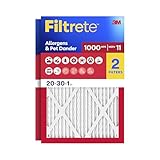
| Filtrete 20x30x1 MERV 11 (2-Pack) | Pet dander and allergens in wide filter slots | $22.72 |
| Filterbuy 16x20x1 MERV 8 (4-Pack) | Dust and allergy defense in compact systems | $30.56 |
| Filtrete 16x25x1 MERV 11 (4-Pack) | Comprehensive allergen filtration in mid-size units | $56.50 |
| Filtrete 14x30x1 MERV 5 (6-Pack) | Basic dust defense in narrow, tall slots | $27.96 |
How We Picked
We narrowed this list by weighing four criteria that matter most in this category. First, MERV rating relative to price per filter, since overpaying for filtration your system cannot handle wastes money while under-filtering leaves allergens unchecked. Second, actual size versus nominal size, because a filter that does not seal against the slot wall lets unfiltered air bypass the media entirely. Third, pack count and replacement interval, which together determine your annual cost. Fourth, aggregated owner reports on airflow restriction, since a pleated filter that collapses after two weeks defeats its own purpose.
The 8 Best Air Conditioner Filters in 2026
Amazon Basics 20x20x1 MERV 11 (6-Pack)
This is the pick for households with allergies or pets that want strong filtration without paying a premium brand markup. At MERV 11, it captures fine particles including mold spores and bacteria, while the electrostatic charge helps the media attract dust even before air passes through it.
- Pro: Highest filtration efficiency on this list at the lowest per-unit cost among MERV 11 options.
- Pro: Actual size of 19.75 x 19.75 x 0.75 inches fits snugly in most standard 20×20 slots with minimal bypass.
- Con: Only available in 20×20; not a fit if your system uses a different nominal size.
Skip this one if your HVAC unit is older or uses a lower-capacity blower motor, since MERV 11 can create noticeable airflow restriction in systems not designed for it.
Filtrete 20x20x1 MERV 5 (6-Pack)
For homeowners in low-allergen environments who primarily want to keep lint and visible dust out of the system, this Filtrete pleated option delivers adequate protection with minimal airflow resistance.
- Pro: MERV 5 rating means virtually no pressure drop, making it safe for any residential blower.
- Pro: Filtrete brand reliability and wide availability for easy replacements.
- Con: Per-filter cost is the highest on this list despite the basic MERV rating.
Skip this if you have allergy sufferers or pets; it captures only large particles and will let fine allergens circulate.
Filtrete 20x25x1 MERV 5 (6-Pack)
Homes with a 20×25 filter slot can get basic dust defense here at a very competitive price point. The pleated electrostatic design removes lint and larger dust particles effectively.
- Pro: Lowest per-filter cost among the Filtrete options for larger slot sizes.
- Pro: Actual dimensions of 19.69 x 24.69 x 0.81 inches provide a proper fit with slight clearance for easy installation.
- Con: MERV 5 means no meaningful allergen capture.
Skip this if your primary goal is reducing allergens or pet dander in the air; look for a higher MERV in this size instead.
Amazon Basics 16x20x1 MERV 8 (6-Pack)
Smaller window units and compact central systems that accept a 16×20 filter benefit from this MERV 8 option, which targets pollen, dust, and lint with balanced airflow. It is a strong middle-ground choice.
- Pro: MERV 8 captures pollen and mold spores while imposing only moderate airflow restriction.
- Pro: Six-pack pricing works out to a very low cost per replacement month.
- Con: Not suitable for systems requiring a taller or wider filter frame.
Skip this if you need MERV 11 or higher filtration for severe allergies; the media density is adequate but not top-tier.
Filtrete 20x30x1 MERV 11 (2-Pack)
At just $22.72 for a two-pack, this is one of the most cost-effective ways to get high-grade allergen and pet dander filtration if your system uses the wide 20×30 slot. The three-month rated lifespan stretches value further.
- Pro: MPR 1000 and MERV 11 combined with a reliable Filtrete pleat design that maintains airflow over the full interval.
- Pro: Lowest price on this list for MERV 11 filtration.
- Con: Only two filters per pack, so annual replacement cost adds up for homes in dusty areas.
Skip this if your system cannot handle higher pressure drop; verify your blower spec before upgrading from MERV 5 or 8.
Filterbuy 16x20x1 MERV 8 (4-Pack)
Filterbuy offers a solid alternative for compact systems, pairing MERV 8 dust and allergy defense with a four-pack that balances cost and convenience.
- Pro: Competitive pricing for MERV 8, sitting below Amazon Basics on a per-filter basis in this comparison.
- Pro: Four-pack frequency suits households that replace filters monthly during high-use seasons.
- Con: No published MPR rating for cross-reference with Filtrete-equivalent media density.
Skip this if you prefer brand-name consistency across your HVAC maintenance history or need a size other than 16×20.
Filtrete 16x25x1 MERV 11 (4-Pack)
The most complete allergen defense on this list for mid-size slots. Four filters with MERV 11 and MPR 1000 ratings tackle pet dander, pollen, and fine dust while Filtrete’s pleat construction supports steady airflow.
- Pro: Four-pack at the top filtration tier means fewer shopping trips and consistent protection.
- Pro: Actual size of 15.68 x 24.68 x 0.81 inches ensures a secure fit with no bypass.
- Con: Highest total price on this list, making it a premium commitment per replacement cycle.
Skip this if budget is a primary concern or if your system’s blower is rated only for lower MERV media.
Filtrete 14x30x1 MERV 5 (6-Pack)
Homes with the less common 14×30 slot can maintain basic dust and lint defense at a fair price. The pleated electrostatic construction is straightforward and reliable.
- Pro: Among the few options available in 14×30, making it a practical choice for specific HVAC configurations.
- Pro: Six-pack pricing at $27.96 delivers low cost per filter for routine maintenance.
- Con: MERV 5 will not address pollen, mold, or pet dander effectively.
Skip this if your household includes allergy sufferers; no higher-MERV options exist in this size, so a custom-cut frame may be necessary.
Buying Guide
MERV Rating: Matching Efficiency to Your System
MERV ratings scale from 1 to 16, and each number roughly doubles the fine-particle capture ability of the tier below it. MERV 5 handles visible lint and dust. MERV 8 adds pollen and mold spores. MERV 11 captures pet dander and bacteria. The critical rule is that higher MERV means denser media, which increases pressure drop. Check your furnace or air handler manual for the maximum MERV it supports; exceeding it can reduce airflow enough to cause coil freezing in cooling mode or heat exchanger stress in heating mode.
Actual Size vs. Nominal Size: Why the Gap Matters
Nominal dimensions are rounded marketing numbers. Actual size determines fit. A filter measuring 19.75 x 19.75 inches installed in a slot cut for 20×20 leaves a quarter-inch gap where unfiltered air bypasses the media. Look for the actual-size spec in the product listing and compare it to your slot depth and width. Ideally the filter should slide in snugly without force, leaving no visible gap around the frame edges.
Pack Count and Annual Cost Calculation
A six-pack at $36.51 costs about $6.09 per filter. If you replace monthly through heavy-use seasons and quarterly otherwise, that is eight filters per year. Multiply your expected annual replacements by the per-filter price to compare true yearly cost across options. Higher MERV filters often last three months versus one for lower tiers, so a four-pack at MERV 11 may outlast a six-pack at MERV 5 on a calendar basis despite fewer units.
Our Verdict
The top pick is the Amazon Basics 20x20x1 MERV 11 six-pack at $36.51, which delivers the best balance of high-efficiency filtration and per-unit value for the most common residential filter size. For a budget pick, the Filtrete 20x30x1 MERV 11 two-pack at $22.72 offers top-tier allergen protection at the lowest entry price for wider slots. One condition under which another product wins: if your system’s blower is rated only for low-MERV media, the Filtrete 16x20x1 MERV 5 or Amazon Basics 16x20x1 MERV 8 will serve better than anything rated 11, since airflow restriction from a too-dense filter creates real mechanical problems.
FAQ
How often should I replace my air conditioner filter?
Standard guidance is every 30 to 90 days depending on MERV rating, household dust load, and whether pets are present. MERV 11 filters typically carry a three-month rating, while basic MERV 5 pleated options may only last a single month in dusty environments. Owner reports consistently show shorter intervals than manufacturer claims in homes with shedding pets or nearby construction.
Can I use a higher MERV filter than my system recommends?
Not without checking your blower capacity. Higher MERV media is denser, creating more static pressure. If your furnace or air handler motor is undersized for that pressure, airflow drops, the evaporator coil can ice over in cooling mode, and the system short-cycles. Some newer variable-speed blowers handle MERV 13 and above, but most standard residential units are rated for MERV 8 or MERV 11 maximum.
What is the difference between MPR and MERV ratings?
MPR (Micro-Particle Performance Rating) is a Filtrete proprietary metric that measures capture efficiency for particles between 0.3 and 1.0 microns. MERV is the ASHRAE industry standard covering a broader particle-size range. A MPR 1000 roughly corresponds to MERV 11, and MPR 300 aligns near MERV 5. Both are useful, but MERV is the standard for cross-brand comparison.
Do electrostatic air conditioner filters actually work differently than plain pleated ones?
Electrostatically charged media attracts particles as air passes through, capturing some that would otherwise slip past the fiber weave. In practice, the charge degrades over the filter’s life, so the effect is strongest in the first few weeks. The pleated structure itself does the heavy lifting throughout the replacement interval, and electrostatic enhancement is a secondary benefit rather than a primary mechanism.