Key takeaways
- Pro: European manufacturing at under $8 per glass is uncommon in this bracket
- Pro: Consistent owner reports of a clean, thin rim without fragile edges
- Con: At 13.5 oz, the bowl may feel small if you habitually pour generously
What's inside
White wine is unforgiving of bad glassware. A thick, blunt rim disrupts the flow of a delicate Sauvignon Blanc across your palate, and an overly wide bowl lets aromatics dissipate before you notice them. The problem most buyers face isn’t that quality options don’t exist—it’s that the market is flooded with visually similar sets where the differences hide in bowl taper, rim thickness, and glass composition, none of which you can assess from a product photo alone.
Across the eight sets below, the meaningful separation comes down to how each handles the tension between elegance and durability. Thin-rimmed crystal delivers a more refined drinking experience but demands hand-washing and careful storage. Thicker, dishwasher-safe glass earns its place through practicality at a fraction of the cost. This roundup compares published specifications, material descriptions, and consistent owner feedback to identify where each set falls on that spectrum, so you can match the right glass to your actual routine rather than an aspirational one. The 2026 market offers enough genuine quality at every price tier that settling for a generic tumbler is no longer the only affordable option.
As an Amazon Associate we earn from qualifying purchases at no extra cost to you. Product prices and availability are accurate as of the date shown and are subject to change.





Quick Picks
| Product | Best For | Price |
|---|---|---|
| JoyJolt Layla | Everyday elegance at mid-range value | $28.95 |
| Amazon Basics Stemmed | Budget party stock and casual dining | $14.45 |
| Hand-Blown Crystal Gift Set | Gifting on a modest budget | $19.99 |
| OJA Crystal Hand Blown | Thinner rim with larger capacity | $29.97 |
| Set of 12 Long Stem | Large gatherings and entertaining | $32.99 |
| Lead-Free Red/White 4-Pack | Versatility across wine styles | $26.85 |
| Spiegelau Wine Lovers | Brand-relied consistency for varietal-specific pours | $28.97 |
| Crystal Thin Rim 14oz | Upgraded daily-drinking crystal | $29.99 |
How We Picked
We evaluated these sets against four criteria that directly affect the drinking experience: bowl geometry (narrower taper preserves aromatics and keeps white wine cooler longer), rim quality (thinner, laser-cut rims deliver liquid more cleanly to the palate), material composition (lead-free crystal offers brilliance and a perceptibly lighter feel versus standard soda-lime glass), and cost per glass relative to build claims. Owner feedback from verified buyers anchored the reliability dimension—specifically how consistently a set matched its advertised weight, clarity, and dishwasher tolerance over months of use.
The 8 Best White Wine Glasses in 2026
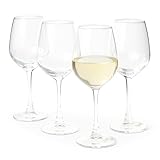
JoyJolt Layla White Wine Glasses, Set of 4
Positioned squarely in the “upgrade from the starter set without committing to premium” category, the Layla holds 13.5 ounces—slightly below average capacity for this list but sufficient for most white pours. Owners consistently praise the clarity and weight balance, noting that the glasses feel substantial without being top-heavy. Made in Europe, they carry a credibility that generic sets lack at this price.
- Pro: European manufacturing at under $8 per glass is uncommon in this bracket
- Pro: Consistent owner reports of a clean, thin rim without fragile edges
- Con: At 13.5 oz, the bowl may feel small if you habitually pour generously
Skip it if you need dishwasher-compatible sets for high-volume entertaining; the delicate rim that makes these pleasant to drink from demands hand care.
Amazon Basics Stemmed White Wine Glasses, Set of 4
Twelve ounces, classic proportions, dishwasher-safe. The Amazon Basics set solves one specific problem extremely well: providing four functional stemmed glasses for the least money. Owner feedback highlights the no-surprise reliability—these look and behave exactly as the listing describes, which in the budget tier is genuinely rare.
- Pro: Dishwasher-safe construction removes the maintenance barrier entirely
- Pro: Lowest cost per glass in this roundup by a wide margin
- Con: Rim thickness is noticeably greater than crystal alternatives, softening the pour
Skip it if you’re buying for someone who already owns mid-range crystal; the perceptual step-down from thicker glass is immediate at the table.
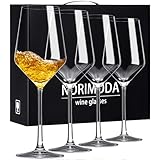
White Wine Glasses Set of 4, 14oz Crystal Hand Blown
A hand-blown set marketed explicitly as a gift, which shapes the experience. The 14-ounce capacity sits above average for this list, and the long stem reads as intentional in presentation packaging. Owners on the gifting side report positive reactions from recipients; the concern clusters around variation in stem alignment, a known trade-off with hand-blown production at this price.
- Pro: Gift-ready presentation without a premium markup
- Pro: 14 oz capacity accommodates generous pours while maintaining a narrower bowl profile
- Con: Hand-blown variability means individual glasses in the set may not match perfectly
Skip it if uniformity matters for your table setting—machine-pressed sets deliver more consistent geometry at comparable prices.
OJA Wine Glasses Set, Crystal White Hand Blown, 15 oz
The largest-capacity set in this roundup at 15 ounces, the OJA appeals to drinkers who prefer generous pours without switching to a wide-bowl format. Hand-blown crystal gives the rims a refined, tapered edge that budget glass can’t replicate. Owners describe the stem as sturdy for its length, countering the fragility worry that typically follows hand-blown construction.
- Pro: Largest capacity here while maintaining a relatively narrow taper for aroma retention
- Pro: Thick-stem base provides stability that longer, thinner stems sometimes lack
- Con: At nearly $30, it enters Spiegelau territory without that brand’s proven consistency
Skip it if you’re a lighter pourer; the 15-ounce bowl will leave a significant portion of the glass empty, which affects both aesthetics and aeration.
Wine Glasses Set of 12, 12oz Clear Red/White Wine Cup
Twelve glasses at roughly $2.75 each is the value proposition, and for hosts who regularly entertain, that math is hard to ignore. The dual-purpose labeling (red/white) signals a compromise geometry—wider than ideal for whites, narrower than ideal for reds. Owner reviews consistently confirm it looks fine on a crowded table but feels average to drink from.
- Pro: Per-glass cost that no other set in this roundup approaches
- Pro: Neutral design works with any table setting without demanding attention
- Con: Compromise bowl shape means neither red nor white performance is optimized
Skip it if white wine is your primary pour; the generic bowl shape won’t preserve aromatics the way a dedicated taper would.
Wine Glasses Set of 4, 14oz Lead-Free Red/White With Stem
A middle-ground set that explicitly calls out lead-free construction—a detail budget products often leave unstated. Fourteen ounces with a red/white designation mirrors the 12-pack compromise above but in a smaller footprint. Owners report the thickness-to-sturdiness ratio feels like a deliberate choice for durability rather than a cost-cutting measure.
- Pro: Lead-free designation confirms material safety without a crystal price premium
- Pro: Four-pack size suits households that don’t host frequently but want better-than-basic glass
- Con: The dual red/white labeling again signals a bowl geometry that’s serviceable but not focused
Skip it if you’re a dedicated white wine drinker who wants a purpose-built taper; dedicated white sets in the same price range offer more precise bowl shape.
Spiegelau Wine Lovers White Wine Glasses, Set of 4
Spiegelau carries the strongest brand recognition in glassware for a reason: consistent manufacturing tolerances that translate directly into a reliable pour experience. The varietal-specific naming (Chardonnay, Sauvignon Blanc, Riesling) reflects a narrower bowl profile engineered to concentrate the floral and citrus notes that make these whites distinctive. Owner feedback aligns with expectation—these look and perform as advertised, repeatedly.
- Pro: Brand consistency means every glass in the set matches the others without variation
- Pro: Lead-free crystal delivers the optical clarity and rim thinness that justify the category
- Con: Care requirements are unforgiving; dishwasher heat and detergent can cloud the crystal
Skip it if your household doesn’t currently have dedicated hand-wash capacity; the maintenance cost of keeping these pristine adds up over time.
Crystal Wine Glasses Set of 4, 14oz, Sturdy Bowl, Thin Rim
A straightforward description that promises what matters: a thin rim for clean liquid delivery and a sturdy bowl to resist the fragility anxiety that makes people avoid crystal sets. The 14-ounce capacity is mid-range for this list. Owners report the thin rim is genuinely present, distinguishing it from products that claim delicacy while shipping with rolled edges.
- Pro: Thin rim confirmed by multiple owner reports, avoiding the most common disappointment in budget crystal
- Pro: Sturdy-bowl construction bridges the gap between daily-use tolerance and refined appearance
- Con: At $7.50 per glass, it sits just under Spiegelau without that brand’s track record for consistency
Skip it if you want absolute confidence in uniformity across a four-pack; brand-name alternatives at similar prices offer tighter quality control guarantees.
Buying Guide
Bowl Shape and Capacity
White wine glasses benefit from a narrower, slightly more tapered bowl than reds. The logic is thermal and aromatic: a smaller opening slows oxygen exposure, keeping whites cooler longer, while the taper funnels volatile compounds toward the nose. Capacity between 12 and 15 ounces covers most home pourers comfortably, but if your standard serving is four ounces, a 15-ounce bowl leaves most of the glass empty and defeats the purpose of the taper.
Rim Thickness and Material
Rim thickness is the single most perceptible feature when drinking. Thin, laser-cut edges on crystal deliver liquid in a clean, uninterrupted flow; thicker rolled rims on standard glass create a slight pooling effect before the wine reaches your tongue. The trade-off is durability—thin crystal rims chip if they contact the dishwasher rack or a hard surface. If you plan to machine-wash your set, accept the rim compromise in exchange for longevity.
Stem Length and Set Size
Longer stems (common across most sets here) serve a functional purpose beyond aesthetics: they keep your hand away from the bowl, preventing body heat from warming chilled whites. Set size should match your realistic usage pattern. A four-pack that sits unwashed in a cabinet for months defeats its value; a twelve-pack you use twice a year at parties may be the honest choice for your actual lifestyle.
Our Verdict
The Spiegelau Wine Lovers set is our top pick for anyone drinking white wine as a primary ritual rather than an occasional pour. The brand’s consistency, varietal-specific geometry, and confirmed thin-rim performance justify the care requirements. For the budget pick, the Amazon Basics set wins on an unbeatable cost-per-glass ratio and dishwasher tolerance—accept the thicker rim and you get a functional four-pack that outlasts expectations. The condition where another product takes priority: if you’re buying specifically for a gift, the hand-blown 14-ounce crystal set at $19.99 delivers the most presentable package for the money, with packaging and perceived craftsmanship that Spiegelau’s retail-focused presentation doesn’t match at that price.
FAQ
Do white wine glasses need to be smaller than red wine glasses?
Not necessarily smaller in total volume, but narrower at the opening. The critical difference is bowl taper: white wine glasses funnel aromatics through a tighter opening, while red wine glasses allow wider swirl-to-oxidation. A 14-ounce white wine glass can hold the same volume as a 14-ounce red glass while still producing a measurably different drinking experience.
Is lead-free crystal worth the price over standard glass?
For the rim experience, yes—crystal allows a thinner, sharper edge that standard glass can’t achieve without becoming fragile. Beyond that, lead-free crystal offers optical clarity and a perceptibly lighter feel. The practical cost is maintenance: crystal is more susceptible to clouding from dishwasher detergent and heat.
How many ounces should I pour into a white wine glass?
The standard professional serving is five ounces, which is less than most home pourers think. A useful visual reference is one-third of the bowl’s capacity—this preserves headroom for swirling without spilling and keeps the wine below rim height so the taper can concentrate aromatics.
Can white wine glasses go in the dishwasher?
Durable, thicker-rimmed sets (like the Amazon Basics and the 12-pack) are explicitly labeled dishwasher-safe and tolerate it well. Thin-rim crystal and hand-blown sets should be hand-washed with warm water and a soft brush to avoid rim chips, clouding, and stem stress points that heat cycles accelerate over time.