Best Absinthe Spoon Sets for the Louche Ritual
The best absinthe spoon set for louche ritual is usually a three- or four-spoon stainless-steel set with a broad, perforated bowl, a stable bridge, and handles of roughly 16–17 cm (6.3–6.7 in)—a combination that supports a sugar cube without flexing or slipping across the glass.
For traditional preparation, the spoon is not decorative cutlery. It must rest securely on the rim, hold a cube above the absinthe, and let chilled water pass through at a controlled rate. Spoon pattern, bowl support, metal quality, handle length, and set size therefore matter more than an ornate finish or a low price.
Our top picks
 Absinthe Spoon Set of 4
- ★ 4x Original ALANDIA Absinthe Spoons with 19th…
- ★ The Absinthe spoons are made of polished…
- ★ Every Absnthe spoon is packed in a…
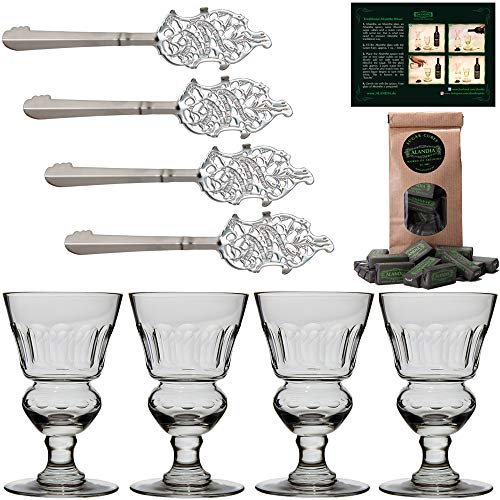 Absinthe Spoons Glasses Set by ALANDIA
- ★ 4x Original Absinthe glasses in classic 19th…
- ★ 4x Authentic Absinthe spoons "Feuilles" made of…
- ★ 1x Large bag of indivdually wrapped ALANDIA…
As an Amazon Associate we earn from qualifying purchases at no extra cost to you.
What to look for before buying
1. A bowl designed for sugar and water
Choose a bowl with several slots or perforations rather than a few oversized holes. A dense pattern spreads water across the sugar and encourages an even dissolution. Large holes can send water through in narrow streams, while tiny punched holes may clog with sugar residue.
A useful bowl is approximately 4.5–6.5 cm (1.8–2.6 in) long and 2–3 cm (0.8–1.2 in) wide. It should be deep enough to cradle a standard sugar cube but not so concave that the cube becomes difficult to position. A completely flat spoon can work, but a gently raised center or shallow side rails offers better support.
2. A bridge that fits the glass
The underside of the spoon should have a clear support bridge, preferably with two contact points. This keeps the bowl centered over the glass and prevents the handle from rotating as water is added. A narrow, sharply curved bridge can mark thin glass rims or sit awkwardly on modern tulip-shaped absinthe glasses.
Before ordering, measure the rim of your glass. Most traditional glasses accept a bridge span of about 4–6 cm (1.6–2.4 in), but a spoon intended for a narrow tasting glass may not sit safely on a broad reservoir glass. If your collection includes several glass shapes, a set with moderately wide, straight support rails is more versatile than a highly curved specialty design.
3. Metal quality and finish
Food-grade stainless steel is the most practical choice for frequent use. Stainless steel resists tarnishing, tolerates hand washing, and is less demanding than silver-plated metal. Look for a stated grade such as 18/8 or 18/10 stainless steel; these figures refer to the approximate chromium and nickel content and generally indicate a corrosion-resistant alloy.
Silver-plated spoons can be attractive and appropriate for occasional ceremonial service, but the plating is a wear layer. Abrasive cleaners, dishwashers, and prolonged contact with acidic residues can eventually expose the base metal. Solid sterling silver has heirloom appeal, though it requires polishing and usually costs considerably more.
Be cautious with very thin, mirror-finished spoons. A bright surface does not indicate strength. For a durable everyday set, a bowl and bridge that feel rigid under light thumb pressure are more important than a highly reflective finish.
4. Handle length and balance
Handles around 16–17 cm are long enough to keep fingers away from the wet sugar and glass while remaining easy to control. Handles below 14 cm can feel cramped over a tall glass. Handles above 19 cm may look dramatic but can make a light spoon feel top-heavy, especially when the bridge is narrow.
The handle should be aligned with the bowl rather than twisted to one side. A centered, moderately broad handle is easier to lift after the louche and less likely to rotate while you pour. Decorative cutouts are harmless when the metal remains rigid, but deeply pierced handles can trap sticky sugar and complicate cleaning.
Head-to-head: which spoon set suits your ritual?
| Spoon set type | Typical specifications | Best for | Advantages | Limitations |
|---|---|---|---|---|
| Budget stainless set | 3 spoons; 15–16 cm; 18/0 or unspecified stainless steel; 18–28 g each | New drinkers and occasional use | Low replacement cost; easy to clean; enough for a small home bar | Bridge may flex; finish and hole edges can be inconsistent |
| Heavy-duty 18/8 or 18/10 set | 4 spoons; 16–17 cm; 25–40 g each; 4–6 cm bridge span | Regular home use and entertaining | Rigid bowl support; better balance; usually dishwasher-tolerant when specified | Costs more and may be bulkier in a shallow utensil drawer |
| Ornamental French-style set | 2–4 spoons; 16–18 cm; pierced or embossed bowl; often 20–35 g each | Presentation-focused service | Distinctive patterns; attractive on a serving tray | Intricate surfaces retain sugar; some bridges fit only certain glasses |
| Silver-plated or sterling set | 2–4 spoons; 16–18 cm; approximately 25–45 g each | Occasional formal use and collecting | Traditional appearance; potentially long ownership life with care | Polishing required; plating can wear; higher general market price |
Best choices by situation
- Best for a first set: choose three 18/8 stainless spoons with a medium-width perforated bowl and a bridge span of about 4.5–5.5 cm. Three spoons cover a couple preparing drinks together without paying for a large service set.
- Best for frequent preparation: choose four heavier spoons, ideally 25–40 g each, with smooth punched holes and a rigid two-point bridge. The extra spoon means you can continue serving while another is soaking or drying.
- Best for limited storage: choose a two-spoon set with a straight bridge and a handle no longer than 17 cm. Avoid oversized decorative designs that occupy more drawer space without improving control.
- Best for mixed glassware: choose a medium, relatively flat bridge and a bowl about 5 cm long. It is more adaptable than a narrow spoon made for one reservoir-glass profile.
- Best for display: choose a silver-plated or ornamental spoon only if you accept polishing and more careful washing. Presentation patterns are not automatically better at dissolving sugar.
- Best for a tight budget: buy fewer, better-formed spoons rather than a ten-piece novelty set. A two- or three-spoon stainless set with cleanly finished holes is more useful than a larger set with flimsy bridges.
How the spoon changes the louche
Place the spoon bridge across a clean glass rim and set one sugar cube in the center of the bowl. Add chilled water slowly—roughly 1 teaspoon at a time at first—so the cube absorbs water instead of collapsing immediately. As the cube softens, increase the flow to a thin stream. The classic preparation commonly uses about three to five parts water to one part absinthe, although the final ratio depends on the absinthe and personal preference.
The spoon should remain stable throughout. If it rocks, the bridge is too narrow for the glass, the bowl is off-center, or the handle is being used as a lever. Do not press down on the cube. The spoon’s job is to distribute water, not to force sugar through the holes.
A practical timing check is more useful than chasing a fixed number: a standard cube should soften over approximately 2–5 minutes with a slow pour. If water races through in seconds, the holes may be too open or the pour too aggressive. If the cube remains dry after several minutes, the pattern may be too restrictive or the cube may be oversized.
Durability, cleaning, and ownership costs
The first parts to wear are usually the bridge joints, thin decorative sections, and plated surfaces—not the main bowl. Inspect each spoon when it arrives. Reject one with a rocking bridge, sharp punched edges, a visibly twisted bowl, or a handle that bends under modest finger pressure.
Rinse the spoon soon after use. Dried sugar is water-soluble, so a few minutes in warm water usually removes it without scrubbing. Use a soft brush around the perforations, then dry thoroughly. Stainless steel can often go in a dishwasher, but hand washing is gentler on polished surfaces and essential for many plated or vintage spoons. Never use steel wool or abrasive powder on silver plate.
To compare value, consider use rather than piece count. For example, a four-spoon stainless set costing a general market price of $25–$45 and used once a week for three years provides about 156 service occasions. At $35, that is roughly $0.22 per occasion before replacement—provided the bridge remains rigid and the finish survives cleaning. A cheaper set that must be replaced after a few months may cost more over time.
Final buying verdict
For most home bars, the strongest choice is a four-piece 18/8 or 18/10 stainless set with 16–17 cm handles, a 5–6 cm two-point bridge, and a gently curved bowl with evenly spaced perforations. It offers the best balance of stability, cleaning ease, versatility, and replacement value.
Choose a two-piece set when storage and occasional use matter most; choose an ornamental or silver option when presentation outweighs maintenance. Whatever the style, prioritize a rigid bridge and cleanly finished bowl over a high piece count. Those two details determine whether the spoon supports a controlled louche or merely decorates the glass.