Key takeaways
- Best for a dinner party: A broad-base, 1.5-litre lead-free crystal decanter with a relatively narrow neck. It aerates a standard bottle efficiently without requiring several small pours.
- Best for one or two glasses: An aerating pourer such as the Vintorio Wine Aerator Pourer. It adds air as wine is poured and avoids storing a large glass vessel.
- Best when speed matters: An electric aerator such as the Aervana Electric Wine Aerator. It is useful when several bottles need serving in succession, though it adds batteries, charging, and cleaning parts.
- Best for older reds: A traditional decanter with a gentle, controlled pour and a clean shoulder or stopper area. Excessive agitation can make delicate mature wine lose its balance quickly.
- Best for tight storage: A compact 750–900 ml carafe or an aerating pourer. Full-size decanters are awkward to protect in crowded cabinets.
- Best value: A simple lead-free glass decanter with a broad base. It usually provides more meaningful aeration than a decorative narrow vessel at a lower cost.
Best Aerating Wine Decanters
The best aerating wine decanter for most people is a 1.2–1.5 litre, lead-free glass or crystal decanter with a broad base and a manageable neck; choose a rapid aerating pourer for quick single-glass service, an electric aerator for speed and accessibility, or a traditional decanter when sediment removal and presentation matter most.
Quick picks by situation
- Best for a dinner party: A broad-base, 1.5-litre lead-free crystal decanter with a relatively narrow neck. It aerates a standard bottle efficiently without requiring several small pours.
- Best for one or two glasses: An aerating pourer such as the Vintorio Wine Aerator Pourer. It adds air as wine is poured and avoids storing a large glass vessel.
- Best when speed matters: An electric aerator such as the Aervana Electric Wine Aerator. It is useful when several bottles need serving in succession, though it adds batteries, charging, and cleaning parts.
- Best for older reds: A traditional decanter with a gentle, controlled pour and a clean shoulder or stopper area. Excessive agitation can make delicate mature wine lose its balance quickly.
- Best for tight storage: A compact 750–900 ml carafe or an aerating pourer. Full-size decanters are awkward to protect in crowded cabinets.
- Best value: A simple lead-free glass decanter with a broad base. It usually provides more meaningful aeration than a decorative narrow vessel at a lower cost.
How the main designs compare
| Decanter type | Typical capacity | Useful aeration time | Pour control | Cleaning difficulty | Storage requirement |
|---|---|---|---|---|---|
| Broad-base glass or crystal | 1.2–1.8 L | 20–90 minutes | High | Moderate | High; needs protected shelf space |
| Narrow carafe | 0.75–1.0 L | 30–120 minutes | High | Easy to moderate | Moderate |
| Built-in aerating pourer | 750 ml bottle interface | Immediate while pouring | Moderate | Easy to moderate | Low; drawer or bottle-cabinet storage |
| Electric aerator | 750 ml bottle interface | Immediate while pouring | High and repeatable | Moderate to difficult | Low to moderate; charger and accessories |
| Decanter with filter or screen | 1.0–1.5 L | 15–60 minutes | High for sediment | Moderate to difficult | Moderate to high |
These are practical operating ranges rather than guarantees. Wine temperature, fill level, surface area, age, and grape variety can change the result substantially. A large base accelerates oxygen contact, while a narrow opening helps contain splashing and makes controlled pouring easier.
Our top picks
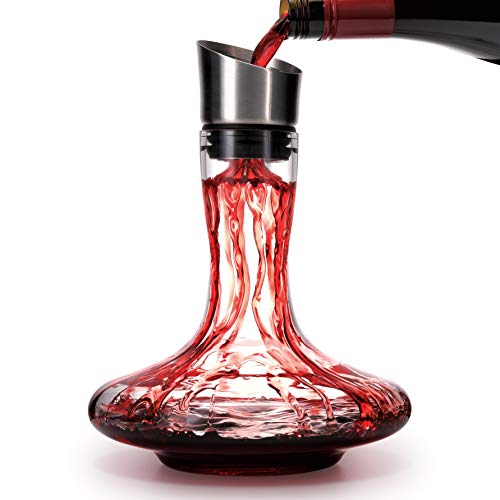 Wine Decanter Built-in Aerator
- Designed for wine lover , suitable for a…
- It is different from the traditional decanter ,…
- Considering the situation during daily use, our decanter…
 Le Chateau Large Elegant Crystal Wine Decanter
- Elevate your wine experience
- Designed to aerate a full bottle of wine,…
- HAND BLOWN, LEAD-FREE CRYSTAL GLASS: Crafted from superior,…
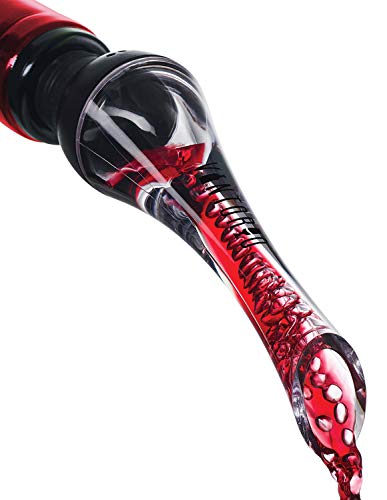 Vintorio Wine Aerator Pourer
- Aerate Your Wine to Perfection Instantly - The…
- Keep Your Tablecloth Safe from Wine Stains -…
- Elegantly Designed and Made with Quality Materials -…
| Product | Key specs | |
|---|---|---|
| Wine Decanter Built-in Aerator | Designed for wine lover , suitable for a… It is different from the traditional decanter ,… Considering the situation during daily use, our decanter… | Check price |
| Le Chateau Large Elegant Crystal Wine Decanter | Elevate your wine experience Designed to aerate a full bottle of wine,… HAND BLOWN, LEAD-FREE CRYSTAL GLASS: Crafted from superior,… | Check price |
| Vintorio Wine Aerator Pourer | Aerate Your Wine to Perfection Instantly - The… Keep Your Tablecloth Safe from Wine Stains -… Elegantly Designed and Made with Quality Materials -… | Check price |
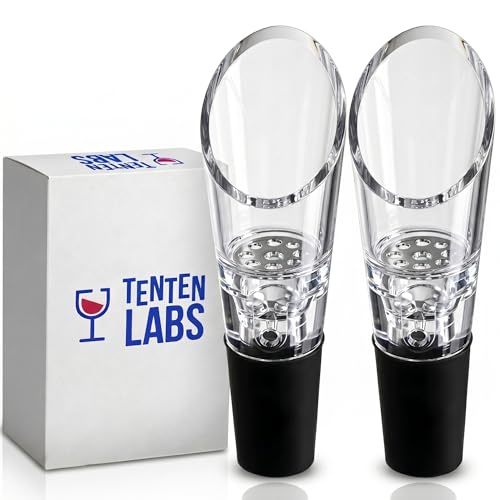 TenTen Labs Wine Aerator Pourer | This wine aerator pourer spout uses the Bernoulli… DOUBLE PACK, EXTRA VALUE: Includes 2 wine aerator… FREE, EASY-CLEAN DESIGN: The elongated spout delivers a… | Check price |
As an Amazon Associate we earn from qualifying purchases at no extra cost to you.
Head-to-head: decanter versus aerating pourer
Traditional decanter
A traditional decanter gives the wine a large exposed surface and lets you separate sediment as you pour. It is the stronger choice for full-bodied young reds such as Cabernet Sauvignon, Syrah, Malbec, and many youthful red blends. It also looks more appropriate for a table service setting.
The trade-off is planning. A standard 750 ml bottle fills a 1.2–1.5 litre decanter only halfway, which is useful because it leaves surface area for air but can make the vessel appear oversized. The wine may need 20 minutes for a modest lift or 60–90 minutes for a tightly structured young red. Older Pinot Noir, mature Bordeaux-style blends, and fragile Nebbiolo may need only a careful decant and short rest.
Aerating pourer
An aerating pourer is better when guests want wine at different times or when only one glass needs opening. It exposes wine to air during the pour rather than asking the whole bottle to rest. This makes it convenient for weeknight use, tasting flights, and bottles shared over several hours.
Its limitation is incomplete sediment control. Many pourers contain a small screen, but they do not replace a slow, angled decant for a bottle with substantial deposits. They can also create foam or splashing if the bottle is tilted aggressively. Pour slowly and stop before the last cloudy portion reaches the spout.
Capacity and serving-size calculation
Capacity is not the same as useful working volume. For comfortable aeration, leave roughly 25–40% of the vessel empty. A 1.5-litre decanter therefore works well with one 750 ml bottle, while a 1.0-litre model is better for a single bottle with less room for swirling.
For two bottles, calculate 1,500 ml of wine, then add headroom. A decanter would need at least 2.0 litres to aerate both bottles comfortably, but moving that much liquid becomes heavier and increases spill risk. In practice, two 1.2–1.5 litre decanters are easier to handle and allow different wines to be served at different times.
Materials: lead-free glass, crystal, and metal parts
For routine use, lead-free glass is the sensible baseline. It is generally less expensive, easier to replace, and sufficiently clear for inspecting color and sediment. Lead-free crystal can provide a thinner rim and more refined appearance, but its extra cost is mainly about finish, weight, and presentation rather than dramatically faster aeration.
Look for explicit wording such as “lead-free crystal” or “crystalline glass.” Avoid assuming that every item described simply as “crystal” has the same composition. If the product does not state its material, choose a transparent glass alternative from a manufacturer that publishes material information.
Silicone seals, plastic screens, and small metal springs are often the parts that wear first on aerating devices. They may retain wine aromas, discolor, loosen, or become difficult to clean. Before buying, check whether replacement screens, seals, or charging components are available.
Cleaning difficulty and ownership realities
- Rinse immediately. Warm water removes fresh wine residue more reliably than leaving it overnight.
- Use a soft decanter brush or cleaning beads. Never force a rigid brush around a narrow neck, where leverage can crack the vessel.
- Do not use abrasive powders. Scratches are especially visible in clear glass and can weaken thin walls.
- Drain upside down with airflow. A folded towel inside the neck can trap moisture and create stale odors.
- Disassemble aerators according to their instructions. Flush screens and channels separately; wine trapped inside a hollow pourer can spoil between uses.
Dishwasher compatibility is useful but does not eliminate breakage risk. A tall decanter can strike the rack or another glass, and heat may damage silicone components. Hand washing is usually the safer long-term choice for thin crystal and devices with valves or batteries.
Decision matrix for buying
| Your situation | Recommended design | Why it fits | What to accept |
|---|---|---|---|
| Occasional use and limited budget | Lead-free glass, 1.2–1.5 L | Low purchase cost and useful surface area | More hand washing and cabinet space |
| Frequent entertaining | Two matching broad-base decanters | Parallel service and less overfilling | Higher storage and breakage exposure |
| New to decanting | Decanter with clear fill markings or a pouring lip | Easier to control volume and spills | Usually less sculptural in appearance |
| Small kitchen or apartment | Aerating pourer or 750–900 ml carafe | Fits a drawer or compact shelf | Less effective sediment separation |
| Many young, tannic reds | Broad base, 1.5 L or larger | Maximum air contact and swirling room | Needs timing; over-aeration is possible |
| Mostly older or delicate wines | Traditional narrow-neck decanter with gentle pour | Better control of sediment and oxygen exposure | Slower, less dramatic aeration |
Storage and breakage prevention
Measure the cupboard before purchasing. Allow at least 5 cm of clearance above the stopper or neck, and check whether the base fits a shelf that is deep enough to prevent tipping. Store the decanter upright once completely dry, preferably away from the edge of a shelf. Do not stack other glassware inside it, even if the opening looks wide; pressure at the neck is a common cause of chips.
If the decanter will be used only a few times each year, an aerating pourer may deliver more value despite offering less dramatic presentation. If it will appear at weekly dinners, the extra cleaning and storage of a stable 1.2–1.5 litre decanter are easier to justify.
Final recommendation
Choose a broad-base, lead-free 1.2–1.5 litre decanter for the best balance of aeration, sediment control, capacity, and price. Add an aerating pourer when convenience and storage matter more than full-bottle decanting. Choose an electric model only if immediate, repeatable aeration outweighs its extra parts and cleaning demands. Whatever the design, prioritize a secure grip, a stable base, a washable interior, and materials clearly identified as lead-free.