The best bar tool roll up bag for storage is a waxed-canvas or heavy nylon roll with at least eight pockets, a 12-inch pocket width, a secure buckle or webbing tie, and enough depth for a jigger, strainer, spoon, muddler, bar knife, and two shakers without forcing the closure.
Roll-up bags are useful for home bartenders who need to clear tools from a counter, traveling bartenders carrying a compact kit, and cocktail professionals storing backup equipment. The right choice is less about appearance than whether each tool has a pocket that fits it, whether the fabric tolerates moisture and abrasion, and whether the rolled bundle stays closed in a drawer or transport case.
Our top picks
 TREELF Portable Bartender Bag Travel Bartender Bag
- Durable Materials: Made with heavy-duty canvas fabric and…
- Convenient Carrying: Equipped with leather straps, bronze plated…
- Spacious Storage: Many separated storage compartments to organize…
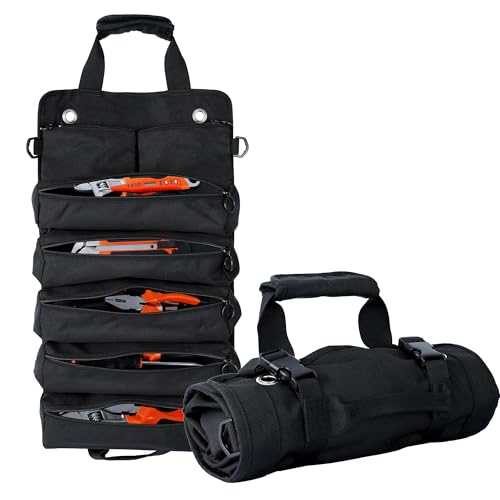 AASTT Portable Foldable Roll Up Tool Bag
- Heavy-Duty Waterproof Construction: This roll tool bag measures…
- Efficient Multi-Pocket Organization: Unroll to reveal multiple deep…
- Portable Roll-Up Design: Rolls up compactly and secures…
As an Amazon Associate we earn from qualifying purchases at no extra cost to you.
Quick comparison: which roll-up format fits your bar?
| Bag type | Typical open size | Pocket arrangement | Closure security | Best use | Typical market range |
|---|---|---|---|---|---|
| Lightweight nylon roll | 19–24 in wide × 12–15 in high | 8–12 pockets, usually 2–4 in wide | Hook-and-loop flap or fabric tie | Occasional home storage and low weight | $20–$45 |
| Waxed-canvas tool roll | 22–28 in wide × 12–16 in high | 8–14 pockets, usually 2.5–5 in wide | Leather or webbing straps with buckle | Frequent use and drawer or shelf storage | $35–$80 |
| Heavy-duty polyester roll | 24–32 in wide × 14–18 in high | 10–16 pockets, often with gussets | Two straps, buckle, or zippered cover | Large kits and transport between venues | $45–$100 |
| Compact bartender roll | 14–20 in wide × 9–12 in high | 5–8 narrow pockets | Single tie or snap | Basic home kit with six to ten tools | $15–$35 |
These are useful buying specifications rather than guarantees for every model. Manufacturers may measure the exterior, interior, or fully opened fabric differently, so check pocket dimensions when the bag will hold unusually long or bulky tools.
Best for most home bars: a medium waxed-canvas roll
A medium waxed-canvas roll is the strongest all-around choice for storage. Look for fabric in the 10–16 oz range, reinforced stitching at pocket openings, and a flap that extends at least 2 inches over the tools. Canvas has enough structure to prevent metal tools from forming a single heavy lump when rolled, while the waxed finish helps resist small spills and condensation.
A practical layout has several 2.5–3.5-inch pockets for a Hawthorne strainer, julep strainer, jigger, bottle opener, citrus knife, and muddler, plus one or two pockets at least 4 inches wide for a shaker tin or bar spoon. A pocket that is 10–12 inches deep accommodates most spoons and muddlers without leaving the handles exposed.
This format is preferable to a very small roll because cocktail tools are often wider at the working end than their handles suggest. A jigger can fit in a narrow sleeve, but stacking a jigger behind a strainer makes the roll bulge and puts stress on the tie or buckle.
Best for travel: a heavy nylon or polyester roll with a cover
For transport, choose a roll made from 600-denier or heavier polyester, or from tightly woven ballistic-style nylon. The important feature is not merely a high denier number; it is a coated or lined base, bar-tacked stress points, and a cover that prevents loose tools from sliding out when the bag is carried vertically.
Two closure straps are safer than one. Place them roughly one-third of the way in from each edge so the load cannot escape through the middle. A buckle or adjustable webbing strap is more dependable than a simple fabric tie when the bag will be moved repeatedly. Hook-and-loop can work, but its grip weakens when lint, citrus fibers, or dust collect in the fastening surface.
A travel roll should have at least 1 inch of spare pocket depth beyond the longest tool. For example, a 9-inch bar spoon should not be placed in a pocket measured at exactly 9 inches: the handle needs clearance for the flap to fold over it without creating a sharp pressure point.
Best for a small collection: a compact six- to eight-pocket roll
A compact roll makes sense when the kit contains only a jigger, shaker, strainer, spoon, muddler, opener, and knife. Its lower material volume allows it to fit in a kitchen drawer, but the trade-off is limited separation. Avoid buying one with several decorative narrow slots if the actual tools need wider pockets.
For a compact kit, prioritize these minimum dimensions:
- Two pockets at least 3 inches wide for a jigger and strainer.
- One pocket at least 4 inches wide for a shaker half or small mixing glass accessory.
- One pocket at least 10 inches deep for a bar spoon or muddler.
- A flap at least 9 inches high to cover tool handles.
If you store two-piece shaker tins, a compact roll may be too tight even when the listed pocket count looks adequate. Measure the widest point of the nested tins, then add about 1 inch for fabric thickness and easy removal.
Head-to-head: canvas versus synthetic fabric
Waxed canvas
- Strengths: abrasion resistance, a stable shape, repairable seams, and a more protective feel around polished tools.
- Weaknesses: heavier than thin nylon, slower to dry, and susceptible to creasing if stored damp.
- Ownership issue: wax can transfer slightly to light-colored surfaces when new or warm. Wipe the exterior before placing it on a pale countertop.
Nylon or polyester
- Strengths: low weight, quick drying, easy wiping, and good resistance to occasional splashes.
- Weaknesses: thin fabric can sag around heavy tools, and unreinforced pocket seams may stretch.
- Ownership issue: sharp bar knives and muddler edges can puncture a lightweight lining if tools are inserted carelessly.
For a stationary home bar, canvas generally gives better organization and protection. For commuting or event work, synthetic fabric often wins because a wet roll is lighter and less troublesome to dry.
Decision matrix by situation
| Your situation | Recommended specification | Why |
|---|---|---|
| Budget-conscious beginner | Compact nylon, 6–8 pockets, one 10-inch deep sleeve | Enough room for core tools without paying for unused capacity |
| Weekly home cocktail maker | Medium canvas, 8–12 pockets, 2 closure straps | Better separation and protection for repeated access |
| Frequent event bartender | 600D+ polyester, 10–16 pockets, covered interior, bar-tacked seams | Handles heavier loads, transport, and quicker cleaning |
| Very limited drawer space | Compact roll under 20 inches open width | Reduces rolled diameter and fits shallow storage |
| Large tool collection | At least 28 inches open width, 14+ pockets, two or three straps | Prevents overpacking and excessive pressure on the closure |
How much capacity do you really need?
Count tools by pocket rather than by item. A useful home kit might include 10 tools but require 12 pockets because the shaker tins need a wide compartment and the two strainers should not share one narrow sleeve. As a quick calculation, allow about 2.5 inches of pocket width for each slim tool and 4–5 inches for each bulky item.
For example, six slim tools at 2.5 inches each require 15 inches of distributed pocket width. Add two 4-inch bulky-tool pockets and the layout needs about 23 inches of practical width, before allowing for seams and side margins. That points to a roll approximately 25–28 inches wide when opened, not a 16-inch compact model.
Care and common storage mistakes
Empty the roll before cleaning it. Shake out citrus peel, rinse-resistant syrup residue, and bar dust, then wipe the fabric with a lightly damp cloth. Do not roll it while wet; trapped moisture can encourage odors, stain metal tools, and soften some adhesives used in synthetic linings. Let it dry fully open with the pockets facing upward.
- Store knives with the blade covered or positioned so it cannot contact the fabric.
- Do not place dripping strainers or tins inside the roll after service.
- Keep heavy shakers in wider pockets rather than forcing them into narrow sleeves.
- Leave roughly 10–15% of pocket space unused so the flap can close without tension.
- Inspect bar tacks and strap stitching first; these usually fail before the main fabric.
For most buyers, the best bar tool roll up bag for storage is a medium waxed-canvas model with reinforced pockets and two adjustable closures. Choose compact nylon when drawer space and low cost matter most, or heavy polyester with a protective cover when the bag will travel frequently. The decisive test is simple: every tool should have a correctly sized pocket, the longest handle should sit fully under the flap, and the loaded roll should close without compression or bulging.