Our Top Picks
 Quietcool QC CL-5400 RF Classic Advanced Whole House5,024 CFM38 x 20 x 38 inches69 poundsCheck on Amazon


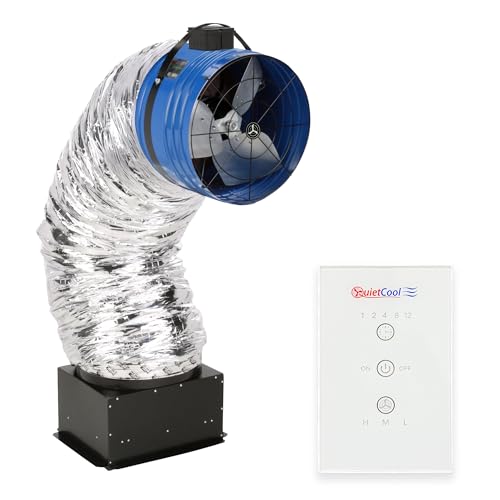

For most single-story homes in the roughly 1,500–2,200 square foot range, the QuietCool QC CL-4700 RF Classic is the best whole house fan for attic installation: it moves up to 4,415 CFM on a two-speed motor, needs about 5.9 square feet of net free attic vent area to breathe, and sits in the premium tier without the venting burden of the biggest Energy Saver units. If your home is smaller or your attic venting is thin, step down to the CL-3100 RF or CL-2250 RF. If you have a large two-story house, a hot garage, or a cold climate that demands a serious insulated damper, the pick changes — the ES-7000 RF, the GA PRO-2.0, and the Tamarack HV1600R38 each solve a problem the CL-4700 does not. This guide compares airflow ratings, attic vent requirements, noise, insulation dampers, motor efficiency, installation clearance, and square-foot coverage so you can match a fan to your actual house instead of to a marketing number.
Top 3 Picks
Best overall: QuietCool QC CL-4700 RF Classic. At up to 4,415 CFM with two speeds, a wireless remote, and an attic-mounted design that keeps the motor out of your living space, it covers the widest band of ordinary homes without demanding an unrealistic amount of attic vent area. It is the fan most buyers should default to.
Best budget: AC Infinity CLOUDWAY S12. A compact 12-inch-class unit with a variable-speed EC motor and a wireless speed controller, it brings efficient motor technology and fine speed control to the lowest price tier in this roundup. It suits smaller homes, additions, and single-zone use where you want control more than raw CFM.
Best premium: QuietCool QC ES-7000 RF Energy Saver. Up to 6,878 CFM with an energy-saving motor makes it the pick for large homes and open floor plans, provided you can supply roughly 9.2 square feet of net free attic vent area and a large ceiling cutout. It moves the most air per watt of anything here.
Quick Comparison
| Product | Best for | Key specs | Price tier |
|---|---|---|---|
| QuietCool CL-4700 RF | Most single-story homes, 1,500–2,200 sq ft | Up to 4,415 CFM, two speed, wireless RF remote, attic mount, ~5.9 sq ft attic vent area | Premium |
| QuietCool ES-7000 RF | Large homes and open plans, 2,300–3,400 sq ft | Up to 6,878 CFM, two speed, energy-saving motor, wireless RF remote, ~9.2 sq ft attic vent area | Premium |
| QuietCool CL-2250 RF | Small homes and cottages, 800–1,200 sq ft | Up to 2,465 CFM, two speed, wireless RF remote, ~3.3 sq ft attic vent area | Mid-range |
| QuietCool CL-3100 RF | Mid-size homes, 1,000–1,550 sq ft | Up to 3,126 CFM, two speed, wireless RF remote, ~4.2 sq ft attic vent area | Mid-range |
| QuietCool CL-5400 RF | Two-story and large open homes, 1,700–2,500 sq ft | Up to 5,024 CFM, two speed, wireless RF remote, ~6.7 sq ft attic vent area | Premium |
| QuietCool GA PRO-2.0 Garage Fan | Garages and workshops | Up to 1,834 CFM, as low as 133 W, integrated fire damper, ~2.4 sq ft vent area | Budget |
| Solatube Whole House Fan EPS Plus | Single-story retrofits with a published coverage figure | 2,502 CFM, listed coverage up to 2,200 sq ft, ~3.3 sq ft attic vent area | Mid-range |
| QuietCool CL-1500 RF | Small spaces, ADUs, upstairs zones | 1,472 CFM, one speed, wireless RF remote, ~2.0 sq ft attic vent area | Mid-range |
| Tamarack HV1600R38 | Cold climates where winter heat loss matters | R-38 insulated doors, 1,600 CFM-class, ceiling mount, strong backdraft sealing | Premium |
| AC Infinity CLOUDWAY T12 | Smart control and temperature-triggered ventilation | 12-inch class, EC motor, WiFi temperature controller, variable speed | Budget |
| AC Infinity CLOUDWAY S12 | Lowest-cost variable-speed control | 12-inch class, EC motor, wireless speed controller, variable speed | Budget |
| Dayton 36″ Whole House Fan | High-volume economy installs with a large cutout | 36-inch fan, 34″ x 34″ opening required, ceiling shutter, belt-drive class | Budget |
How We Chose
This roundup is built from manufacturer specifications, published installation requirements, and the basic physics of how a whole house fan moves air — not from bench measurements or field trials. Every fan here was evaluated against the same seven criteria, because those are the seven things that decide whether a unit actually works in a given attic.
First, airflow rating in CFM, converted into a realistic square-foot coverage band using the standard 2–3 CFM per square foot rule. Second, attic vent requirement, calculated at roughly 1 square foot of net free vent area per 750 CFM, since an under-vented fan simply stalls and turns your attic into a pressurized box. Third, noise character — whether the motor lives in the attic or in the ceiling plane, and how much of the sound path runs through the grille. Fourth, insulation dampers and their R-value, which determines how much conditioned air leaks into the attic all winter. Fifth, motor efficiency and the CFM-per-watt relationship that drives operating cost. Sixth, installation clearance: cutout size, joist and truss interference, and whether the unit needs a dedicated circuit. Seventh, category fit — a garage fan, a cold-climate unit, and a smart-controller fan are not interchangeable, so each was placed where it genuinely belongs. Price tiers reflect general market positioning rather than a specific listing price, since those change constantly.
1. QuietCool CL-4700 RF – Best for Most Single-Story Homes
As an Amazon Associate we earn from qualifying purchases at no extra cost to you.

If your house is a single story in the 1,500–2,200 square foot band and your attic has room for a fan body plus a duct run, the CL-4700 RF is the model most people should start with. At up to 4,415 CFM it can exchange the air in a typical three-bedroom home in a matter of minutes, but it does not demand the enormous attic vent area that the largest Energy Saver unit requires. It is the middle of the QuietCool Classic lineup, and the middle is usually where the math works out.
Like the rest of the Classic RF series, it is an attic-mounted design: the fan body sits in the attic, a ceiling grille sits in the hallway or landing ceiling below, and an insulated damper closes the opening when the fan is off. Two speeds let you run it low overnight and high for the first twenty minutes after you walk in the door. The wireless RF remote means no low-voltage control wiring has to be fished down a wall.
- Airflow: up to 4,415 CFM, two speed
- Sizing band: roughly 1,470–2,210 sq ft at 2–3 CFM per sq ft
- Attic vent requirement: about 5.9 sq ft of net free vent area
- Control: wireless RF remote, two speed
- Mounting: attic-mounted fan, ceiling grille with insulated damper
- Price tier: premium
The strongest argument for the CL-4700 is that it lands in the coverage sweet spot without forcing you into attic venting upgrades. A 4,415 CFM fan needs roughly 5.9 square feet of net free area — about two 24 x 24 inch gable louvers at roughly half their gross area, plus whatever soffit or ridge venting you already have. That is achievable in most older attics. Move up to the 6,878 CFM class and you are looking at 9.2 square feet, which often means adding vents, and adding vents means roof work.
The two-speed control matters more than it sounds. On high, a fan in this class will pull air hard enough that you feel it as a breeze across a doorway. On low, it is a background air exchange you can sleep through. Having only one speed forces you to choose between too much and too little, which is exactly the tradeoff you make with the CL-1500.
Pros
- Airflow sits in the widest useful band — big enough for a full single-story home, not so big that venting becomes a construction project
- Two speeds cover both overnight ventilation and fast cool-down
- Attic-mounted motor keeps the noise source out of the living space
- Insulated damper limits winter air leakage through the ceiling opening
- Wireless RF remote avoids running control wiring to a wall switch
- Shares the Classic series installation pattern, so parts and service are straightforward
Cons
- Premium tier pricing for what is fundamentally a mid-to-large fan
- Still needs about 5.9 sq ft of net free attic vent area, which some older attics cannot supply without added vents
- Classic-series motor is not the energy-saving type found in the Energy Saver line, so watts per CFM is higher
- Requires a ceiling cutout and attic access, so it is not a same-day DIY job for most people
Against the CL-5400 RF, the CL-4700 gives up about 600 CFM and saves you roughly 0.8 square feet of required attic vent area. If your attic venting is borderline, that difference decides it — the CL-4700 will actually outperform a bigger fan that cannot exhaust. Against the CL-3100 RF below it, the CL-4700 buys you real headroom for a two-story or open-plan layout, where air has to travel further to reach the grille.
2. QuietCool ES-7000 RF – Best for Large Homes and Open Floor Plans

The ES-7000 RF is the biggest fan in this roundup and the one to choose when square footage is genuinely large. At up to 6,878 CFM it covers roughly 2,300–3,400 square feet at the standard 2–3 CFM per square foot rule, which puts it in the territory of a big ranch house, a wide open-plan main floor, or a home where the ceiling grille sits at one end and air has to travel the length of the building to reach it. It is also the most efficient unit here, which is the entire point of the Energy Saver name.
Two speeds and a wireless RF remote keep the control scheme familiar, and the attic-mounted body with a ceiling grille and insulated damper follows the same pattern as the Classic series. The difference is under the housing: an energy-saving motor design that moves more air per watt than a conventional motor of the same output.
- Airflow: up to 6,878 CFM, two speed
- Sizing band: roughly 2,290–3,440 sq ft at 2–3 CFM per sq ft
- Attic vent requirement: about 9.2 sq ft of net free vent area
- Motor: energy-saving design, higher CFM per watt than the Classic series
- Control: wireless RF remote, two speed
- Price tier: premium
The single biggest thing to understand about the ES-7000 is that it is a venting commitment. At 6,878 CFM, the 1-square-foot-per-750-CFM rule calls for about 9.2 square feet of net free attic vent area. If you have a continuous ridge vent plus generous soffit venting plus a couple of large gable louvers, you may already be there. If you have one small gable vent and nothing else, you will either need to add venting or accept that the fan will never reach its rated airflow. This is the most common way people waste money on a large whole house fan.
Where the ES-7000 pays you back is runtime. Because the motor is more efficient, the same cooling effect costs fewer watts, and because the fan moves more air, it needs to run for less time to exchange the volume of the house. Those two effects compound. In a large home where a smaller fan would have to run for an hour to do what this one does in twenty-five minutes, the Energy Saver design is not a luxury — it is the reason the install makes sense at all.
Pros
- Highest airflow in the roundup, suited to genuinely large homes and open plans
- Energy-saving motor delivers the best CFM-per-watt relationship of the group
- Two-speed control lets you run it gently on mild nights
- Insulated damper reduces winter leakage through a large ceiling opening
- Attic-mounted design keeps the noise source above the ceiling plane
- Wireless RF remote simplifies the control wiring
Cons
- Requires roughly 9.2 sq ft of net free attic vent area — often a roofing project, not a weekend tweak
- Largest cutout and the most attic clearance of any fan here
- Highest premium-tier cost in the lineup
- Oversized for anything under about 1,800 square feet, where it will be running on low almost permanently
Against the CL-5400 RF, the ES-7000 is the clear step up: about 1,850 more CFM and a more efficient motor, at the cost of roughly 2.5 additional square feet of required attic venting. If you are choosing between those two, the question is not which fan is better — it is whether your attic can exhaust 6,878 CFM. If it cannot, the CL-5400 is the faster fan in practice.
3. QuietCool CL-2250 RF – Best for Small Homes and Cottages

Not every house needs a four-thousand-CFM fan, and the CL-2250 RF is the proof. At up to 2,465 CFM it covers roughly 820–1,230 square feet at the standard sizing rule, which makes it the right call for a cottage, a small bungalow, a cabin, or a compact single-story home where a bigger fan would simply be running on low forever. Two speeds and a wireless RF remote keep it consistent with the rest of the Classic RF family.
The practical advantage of a smaller fan is not just lower cost — it is a dramatically lower attic venting requirement. At about 3.3 square feet of net free vent area, the CL-2250 can often be fed by existing gable and soffit venting with no roof work at all. That single fact frequently makes the smaller fan the better-performing installation, because a properly vented 2,465 CFM fan beats a strangled 4,415 CFM fan every time.
- Airflow: up to 2,465 CFM, two speed
- Sizing band: roughly 820–1,230 sq ft at 2–3 CFM per sq ft
- Attic vent requirement: about 3.3 sq ft of net free vent area
- Control: wireless RF remote, two speed
- Mounting: attic-mounted fan, ceiling grille with insulated damper
- Price tier: mid-range
Two speeds are the difference between this and the CL-1500. On a small house, a single-speed fan at 1,472 CFM is either on or off, and there is no middle ground for a mild spring evening. The CL-2250 lets you run low for background exchange and high for the fast cool-down when you get home from work.
The smaller footprint also helps with installation clearance. A smaller ceiling grille and a smaller fan body fit between trusses more easily, and the attic height requirement is more forgiving. In an older house with a shallow attic and a maze of bracing, that is not a minor consideration — it is often the deciding one.
Pros
- Modest attic vent requirement means it often works with existing venting
- Two speeds give real flexibility on a small floor plan
- Smaller cutout and lighter body simplify attic installation
- Mid-range price tier rather than premium
- Insulated damper and wireless remote carried over from the larger models
- Quiet in practice because the motor sits above the ceiling plane
Cons
- Undersized for anything much above 1,200 square feet, especially with high ceilings
- Will struggle in a long, closed-floor-plan house where air has to travel far
- Still requires a ceiling cutout and attic access
- Classic-series motor, so efficiency trails the Energy Saver line
Compared with the CL-1500 RF, the CL-2250 costs more but buys you a second speed and roughly 1,000 extra CFM — a meaningful upgrade for a house near the 1,000 square foot mark. Compared with the CL-3100 RF above it, the CL-2250 gives up about 660 CFM and 0.9 square feet of required venting. For a small home with limited attic ventilation, that trade is worth taking.
4. QuietCool CL-3100 RF – Best for Mid-Size Homes
The CL-3100 RF is the model that fits the awkward middle: houses that are clearly too big for a compact fan but not so large that they justify the premium of a high-output Energy Saver. At up to 3,126 CFM it covers roughly 1,040–1,560 square feet, which captures a huge share of ordinary two- and three-bedroom homes, especially those with standard eight-foot ceilings.
Its attic vent requirement lands at about 4.2 square feet of net free area. That is the number that makes this fan attractive: it is comfortably within reach of a typical attic with a ridge vent, decent soffit venting, and one or two gable louvers, without adding roof penetrations. You get meaningful airflow without a venting project.
- Airflow: up to 3,126 CFM, two speed
- Sizing band: roughly 1,040–1,560 sq ft at 2–3 CFM per sq ft
- Attic vent requirement: about 4.2 sq ft of net free vent area
- Control: wireless RF remote, two speed
- Mounting: attic-mounted fan, ceiling grille with insulated damper
- Price tier: mid-range
The two-speed control is the same arrangement as the rest of the Classic RF series, and it is genuinely useful at this airflow level. High speed clears a warm house quickly; low speed keeps air moving through the evening without turning the house into a wind tunnel. On a mid-size home, that range is the difference between a fan you use nightly and one you use twice a season.
Installation is also more forgiving than the larger units. The cutout is smaller, the fan body is lighter, and the attic clearance requirement is easier to satisfy in a house with limited headroom above the ceiling. In a house with a low-pitch roof and tight truss spacing, the CL-3100 will often fit where the CL-5400 simply will not.
Pros
- Airflow and venting requirement are well matched to typical mid-size homes
- Approximately 4.2 sq ft of attic vent area is achievable without roof work in many attics
- Two speeds for both quick cool-down and overnight running
- Smaller cutout and lighter body than the premium models
- Mid-range price tier
- Insulated damper and wireless remote included
Cons
- Not enough airflow for a large open plan or a two-story home with a single grille
- Classic-series motor efficiency, not the Energy Saver standard
- Requires attic access and a ceiling cutout
- Under-sized if you have vaulted ceilings that inflate your effective air volume
Against the CL-2250 RF below it, the CL-3100 adds about 660 CFM for roughly 0.9 additional square feet of required venting — a fair trade for anyone above 1,000 square feet. Against the CL-4700 RF above it, it gives up about 1,290 CFM and 1.7 square feet of venting requirement. If your attic venting is the limiting factor, the CL-3100 is the better real-world performer.
5. QuietCool CL-5400 RF – Best for Two-Story Homes

Two-story houses are the hardest case for whole house ventilation. Air enters downstairs, has to travel up a stairwell, and only then reaches the ceiling grille — usually located in an upstairs hallway. That path costs airflow, which is why a two-story home generally needs a larger fan than its square footage alone would suggest. The CL-5400 RF, at up to 5,024 CFM, is built for exactly that situation.
At the standard 2–3 CFM per square foot rule it covers roughly 1,670–2,510 square feet, but on two stories the practical coverage is better than that number implies, because the stack effect works in your favor: warm air naturally wants to rise toward the grille. The fan assists a process the house is already trying to complete.
- Airflow: up to 5,024 CFM, two speed
- Sizing band: roughly 1,670–2,510 sq ft at 2–3 CFM per sq ft
- Attic vent requirement: about 6.7 sq ft of net free vent area
- Control: wireless RF remote, two speed
- Mounting: attic-mounted fan, ceiling grille with insulated damper
- Price tier: premium
The 6.7 square feet of net free vent area this fan needs is the main constraint. That is roughly three 24 x 24 inch gable louvers at half their gross area, or a combination of gable, ridge, and soffit venting that adds up to the same figure. On a two-story house the attic is often larger and better ventilated than on a single-story, so the requirement is frequently easier to meet than it sounds.
The two-speed control is essential at this airflow level. Running 5,024 CFM on high is a whole-house event — doors will pull, and you will feel the pressure. Low speed is where this fan will spend most of its life, with high reserved for the first twenty minutes after arrival. Without the second speed, a fan this size would be difficult to live with.
Pros
- Airflow suited to two-story layouts where air must travel a long path
- Works with the natural stack effect in multi-level homes
- Two speeds make a large fan livable day to day
- Attic-mounted design keeps the noise source out of the living space
- Insulated damper reduces winter leakage through a large opening
- Wireless RF remote avoids control wiring runs
Cons
- Premium pricing
- Requires about 6.7 sq ft of net free attic vent area, which may mean adding vents
- Large cutout and generous attic clearance needed
- Excessive for a single-story home under about 1,600 square feet
Against the CL-4700 RF, the CL-5400 adds roughly 600 CFM and about 0.8 square feet of required attic venting. On a two-story house that extra airflow is worth having, because the air has further to travel. Against the ES-7000 RF above it, the CL-5400 gives up about 1,850 CFM and roughly 2.5 square feet of venting requirement — and for many two-story homes, that trade is exactly right, because the ES-7000’s venting demand is the harder constraint to satisfy.
6. QuietCool GA PRO-2.0 Garage Whole House Fan – Best for Garages and Workshops

Garages are their own ventilation problem. They are unconditioned, they collect heat all day, and they often have no attic above them at all — or an attic that is sealed off from the house. The GA PRO-2.0 is built specifically for that environment: up to 1,834 CFM, as low as 133 watts, and an integrated fire damper that makes it appropriate for a space where a wall or ceiling penetration carries real code implications.
At 1,834 CFM it covers roughly 610–920 square feet at the standard sizing rule, which is a good match for a two-car garage or a workshop. The 133-watt figure is the standout number here: 1,834 CFM at 133 watts works out to roughly 13.8 CFM per watt, an efficiency ratio that most conventional whole house fan motors cannot approach. It also means the fan can run for hours without a meaningful impact on your electricity bill.
- Airflow: up to 1,834 CFM
- Power draw: as low as 133 W (roughly 13.8 CFM per watt at that point)
- Coverage band: roughly 610–920 sq ft at 2–3 CFM per sq ft
- Attic vent requirement: about 2.4 sq ft of net free vent area
- Safety feature: integrated fire damper
- Price tier: budget
The integrated fire damper is the feature that separates this from simply putting a house fan in a garage. A garage is a space where fire separation matters, and a damper designed for that role addresses the concern directly rather than relying on an aftermarket solution. If you are venting a garage attached to a living space, that detail should be near the top of your list.
The modest venting requirement — about 2.4 square feet — also makes this one of the easier installations in the roundup. A garage attic or a gable end usually has enough venting capacity without modification, which is rarely true of the larger whole house fans.
Pros
- Purpose-built for garage and workshop ventilation rather than adapted from a house fan
- Very low power draw at 133 watts, roughly 13.8 CFM per watt
- Integrated fire damper addresses garage fire separation
- Modest attic vent requirement makes installation simpler
- Budget price tier
- Airflow well matched to a two-car garage footprint
Cons
- 1,834 CFM is far too little to ventilate a whole house
- Garage-specific design means it is not a substitute for a home ventilation system
- Coverage band tops out under 1,000 square feet
- Not intended to cool living space, only to exhaust an unconditioned one
Compared with the CL-1500 RF, the GA PRO-2.0 moves more air, draws less power, and includes a fire damper — but it is designed for a garage, not a hallway ceiling. If you are choosing between them, the question is not airflow, it is which space you are ventilating. For an attached garage, the GA PRO-2.0 is the correct answer; for a small living area, the CL-1500 is.
7. Solatube Whole House Fan EPS Plus – Best for Single-Story Retrofits

Solatube is best known for daylighting products, and the EPS Plus applies the same retrofit-minded thinking to ventilation. The listing gives a 2,502 CFM airflow figure and a coverage claim of up to 2,200 square feet, which makes it one of the few fans in this roundup that publishes an explicit square-footage number rather than leaving you to do the math.
That published coverage figure deserves a closer look, because it implies roughly 1.1 CFM per square foot — well below the 2–3 CFM per square foot rule most installers use. That does not make the claim wrong; it makes it a best-case number for a mild climate, an open floor plan, and a house that only needs a moderate air exchange rather than a hard cool-down. If you are in a hot inland climate with a closed floor plan, size up rather than trusting the ceiling of that range.
- Airflow: 2,502 CFM
- Listed coverage: up to 2,200 sq ft (implies about 1.1 CFM per sq ft — treat as a best case)
- Conservative sizing band: roughly 830–1,250 sq ft at 2–3 CFM per sq ft
- Attic vent requirement: about 3.3 sq ft of net free vent area
- Category: quiet cooling fan, single-story retrofit orientation
- Price tier: mid-range
The 3.3 square feet of net free attic vent area this fan requires is the practical good news. That is within reach of most existing attics, which makes the EPS Plus a genuinely installable option for a homeowner who does not want to add roof vents. The airflow is solidly mid-range, comparable to the CL-2250 RF, and the mid-range price tier reflects that.
Where it fits best is a single-story home with a straightforward attic — a clean, unobstructed space with a clear path from the ceiling grille to the exhaust vents. Retrofit-oriented products tend to be designed around that scenario, and a simple attic is where they perform as advertised.
Pros
- Publishes an explicit coverage figure, which simplifies shopping
- Modest attic vent requirement of about 3.3 sq ft
- Mid-range price tier
- Airflow comparable to the CL-2250 RF
- Well suited to single-story homes with clean attic geometry
- Backed by a brand with a long history in home ventilation and daylighting retrofits
Cons
- The 2,200 square foot coverage claim assumes ideal conditions and roughly 1.1 CFM per square foot
- Not enough airflow for a large or two-story home at conservative sizing
- Fewer published control and damper specifications than the QuietCool lineup
- Requires attic access and a ceiling cutout like any attic-mounted fan
Compared with the CL-3100 RF, the Solatube offers about 620 fewer CFM but roughly 0.9 square feet less required attic vent area, and it comes with a published coverage number rather than a sizing rule. If your attic venting is marginal, that difference matters. If your attic is well vented and your house is mid-size, the CL-3100’s extra airflow is the better buy.
8. QuietCool CL-1500 RF – Best for Small Spaces and ADUs

The CL-1500 RF is the smallest fan in the QuietCool Classic RF family, rated at 1,472 CFM with a single speed. It covers roughly 490–740 square feet at conservative sizing, which places it squarely in accessory dwelling unit, studio, upstairs-zone, and small-cottage territory. It is also the least demanding fan here in terms of attic venting: about 2.0 square feet of net free area is usually available in even a modest attic.
The one-speed design is the defining tradeoff. You get 1,472 CFM or nothing. On a small space that is often fine — the room is small enough that the fan does its job in a few minutes and then you turn it off. But on a mild evening when you want a gentle exchange rather than a hard pull, you have no middle setting.
- Airflow: 1,472 CFM, one speed
- Sizing band: roughly 490–740 sq ft at 2–3 CFM per sq ft
- Attic vent requirement: about 2.0 sq ft of net free vent area
- Control: wireless RF remote
- Mounting: attic-mounted fan, ceiling gr
Affiliate disclosure. As an Amazon Associate we earn from qualifying purchases at no extra cost to you. Prices accurate as of the date shown.Best Whole House Fans for AtticsCheck price on Amazon