Key takeaways
- Pro: Full 88-key layout means no upgrade needed when repertoire grows beyond five-octave range.
- Pro: Semi-weighted action with adjustable touch sensitivity builds finger strength more effectively than unweighted keys.
- Con: The included accessories in the bundle add convenience but the bench and stand are basic; owners often replace them.
Buying a piano or piano-adjacent product in 2026 means navigating a crowded field where the term “piano brands” covers everything from full-sized digital keyboards to beginner method books to wall art. The real challenge for most buyers is not finding a piano at all — it is matching the right instrument or accessory to their actual skill level, space, and budget without overspending on features they will never use or under-buying on something that will frustrate them within a month.
What separates a worthwhile purchase from a disappointing one in this category comes down to three things: key action quality relative to price, whether the product solves the specific bottleneck a player faces (finger strength for a beginner, expression control for an intermediate player, or simple inspiration for a casual enthusiast), and build quality at the stated price point. Owner feedback consistently reveals that the cheapest options often lack durability or touch sensitivity, while mid-range products from established names like Alesis deliver surprising value. This roundup compares eight products across those dimensions so you can identify the right fit without reading through hundreds of reviews yourself.
As an Amazon Associate we earn from qualifying purchases at no extra cost to you.




Quick Picks
| Product | Best for | Price |
|---|---|---|
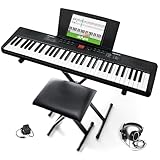
| Alesis Recital Play 88-Key Bundle | Beginners wanting a full-keyboard foundation | $181.99 |
| M-Audio SP-2 Sustain Pedal | Upgrading an existing keyboard’s expression | $25 |
| First 50 Popular Songs Songbook | Players who want recognizable tunes early | $16.10 |
| Alesis Melody 61 MK4 | Casual learners or young students | $85 |
| Alesis Melody 61 MK4 Bundle | Complete starter setup on a tight budget | $106.99 |
| Hit Songs Super Easy Songbook | Adult beginners who want chord support | $15.82 |
| Easy Piano Melodies | Absolute first-time players | $12.15 |
| Open Road Brands Piano Keys Canvas | Gift or decor for a music lover’s space | $44.99 |
How We Picked
We evaluated these products against four criteria drawn from published specifications and aggregated owner feedback: value relative to price, suitability for a clearly defined skill level or use case, build quality and durability as reported by long-term owners, and how well each product addresses a specific gap in a piano-buying journey. A $25 sustain pedal and a $182 keyboard bundle serve entirely different needs, so comparison across the list focuses on whether each product does its intended job well for the money asked, rather than forcing all eight into a single linear ranking.
The 8 Best Piano Brands in 2026
Alesis Recital Play 88-Key Piano Keyboard Bundle
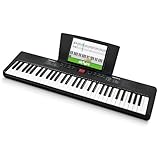
This bundle targets adult beginners and parents buying for teenagers who need full-width key spacing to build proper hand positioning from day one. The 88 semi-weighted keys with adjustable touch response represent a meaningful step above basic 61-key boards, and owner reviews frequently cite the built-in lesson mode as a practical alternative to early paid instruction.
- Pro: Full 88-key layout means no upgrade needed when repertoire grows beyond five-octave range.
- Pro: Semi-weighted action with adjustable touch sensitivity builds finger strength more effectively than unweighted keys.
- Con: The included accessories in the bundle add convenience but the bench and stand are basic; owners often replace them.
Skip this if your space cannot accommodate 88 keys or if you only plan to play casually for a few months before deciding whether to continue.
M-Audio SP-2 Universal Sustain Pedal
For anyone who already owns a keyboard without a sustain pedal, this is the single cheapest upgrade that transforms how the instrument feels. The SP-2 works with virtually all major brands via its dual-connector design, and owners note its polarity switch eliminates the frustrating problem of pedals that sustain when released instead of when pressed.
- Pro: Universal compatibility means it works with the Melody, Recital Play, and most other keyboards on this list.
- Pro: Reversible polarity switch prevents the common polarity mismatch that plagues cheaper pedals.
- Con: The plastic housing feels light and can slide on hard floors during active playing.
Skip this if your keyboard already includes a sustain pedal or if you play primarily on a traditional acoustic piano.
First 50 Popular Songs Songbook
This collection speaks directly to the beginner who loses motivation when forced to practice scales before playing anything recognizable. With lyrics included alongside simplified notation, it lets players sing along while learning, which owners report accelerates note-reading retention. The breadth across pop, jazz standards, and Broadway gives a well-rounded introductory experience.
- Pro: Lyrics let players learn rhythm and phrasing naturally by singing before attempting hands-on execution.
- Pro: Genre variety prevents the monotony that causes many beginners to quit.
- Con: Arrangements are simplified to the point where advanced players will find them musically thin.
Skip this if you already read sheet music comfortably or if your goal is classical technique development rather than playing popular songs quickly.
Alesis Melody 61 MK4 61-Key Piano Keyboard
The standalone Melody 61 MK4 is the entry point for families testing whether a child or beginner will stick with lessons. Its lightweight design and modest price make it a low-commitment instrument. Owners of young students particularly appreciate the built-in speaker volume control, which prevents the frustration of a keyboard that either drowns out practice rooms or is too quiet to hear.
- Pro: Lightweight and portable at a fraction of the weight of 88-key models, making it easy to store or move.
- Pro: Built-in demo songs and recording function give beginners immediate feedback on their playing.
- Con: Unweighted keys do not build the finger strength that transfers to acoustic piano playing.
Skip this if the player intends to audition for school programs or transition to acoustic piano within a year.
Alesis Melody 61 MK4 Bundle
For the buyer who wants a complete practice station without researching individual accessories, this bundle adds a stand, bench, sustain pedal, and learning materials to the 61 MK4. Owners consistently note that purchasing the bundle saves both money and the mental effort of sourcing compatible accessories separately.
- Pro: The bundled sustain pedal and stand eliminate compatibility guesswork for first-time buyers.
- Pro: Total cost is only slightly above the standalone keyboard, making accessories nearly free in value terms.
- Con: The same unweighted-key limitation as the standalone version applies here.
Skip this if you already own a keyboard stand or want to source higher-quality accessories individually.
Hit Songs Super Easy Songbook
Designed for adult learners who find staff notation intimidating, this book uses letter note names printed directly above the notes alongside chord diagrams for left-hand accompaniment. The 60-song selection leans toward recognizable hits, which owners say keeps motivation high during the first critical months of learning.
- Pro: Letter note names remove the initial barrier of note-reading entirely, letting players produce sound from the first page.
- Pro: Chord diagrams teach harmonic thinking alongside melody, building a more complete understanding.
- Con: The simplified approach can create dependency; some owners report difficulty transitioning to standard notation later.
Skip this if you want to develop proper sight-reading skills from the start or already read music fluently.
Easy Piano Melodies for Brand New Players
This is the absolute floor of the learning spectrum — a book for someone who has never touched a keyboard and wants to confirm interest before investing in formal instruction. Owner reviews describe it as confidence-building rather than skill-building, which is precisely its purpose. The melodic simplicity means a learner can play complete musical phrases within an hour.
- Pro: The lowest price among all piano-adjacent products here, making the risk of trying piano nearly zero.
- Pro: Extremely simple arrangements prevent the overwhelm that causes many adults to abandon self-teaching.
- Con: Content is so basic that most players outgrow it within a few weeks.
Skip this if you can read basic notation or already know which keys correspond to letter names.
Open Road Brands Piano Keys Canvas Wall Decor
Not every piano-brand purchase needs to be an instrument. For music lovers decorating a home studio, recital room, or gift recipient’s apartment, this wrapped canvas adds visual warmth at a price well below custom art. Owner photos consistently show it looking more premium than its price suggests, with the gallery wrap eliminating the need for a frame.
- Pro: Gallery-wrapped construction means it is ready to hang immediately without additional framing costs.
- Pro: Makes an ideal gift for a music teacher, student, or pianist who already has adequate equipment.
- Con: Single printed image with limited size options; not customizable.
Skip this if you need a functional product for playing or practicing, or if the recipient prefers minimalist decor.
Buying Guide
Key Count and Weighting
The decision between 61 and 88 keys is the most consequential specification in any piano-brand purchase. Sixty-one keys cover roughly five octaves, sufficient for pop melodies and early lessons, but you will eventually hit a range limit with classical or jazz arrangements. Semi-weighted keys, as found on the Alesis Recital Play, provide resistance that builds finger independence — the mechanical skill that transfers to acoustic pianos. Fully unweighted keys on budget boards feel like a switch press and do not develop that strength. If your budget allows only one purchase and long-term progress matters, the 88-key option almost always wins on value over time.
Accessories and Expandability
A sustain pedal changes a digital keyboard from a toy into something that sounds like a piano. The M-Audio SP-2’s universal compatibility means you can buy it once and carry it across every keyboard upgrade you make over the next decade. When evaluating bundles, compare the individual accessory prices against the bundle total: if the markup is minimal, the convenience of guaranteed compatibility justifies the purchase. Check whether the included stand has adjustable height, since a mismatch between bench height and keyboard position causes wrist strain within a single practice session.
Learning Materials and Motivation Design
Sheet music and songbooks are not interchangeable. A book with letter note names above the staff serves a fundamentally different learner than one using standard notation with chord symbols below. For adult self-teachers, the “Hit Songs” and “First 50” approaches prioritize immediate musicality, which sustains the daily practice habit more effectively than method books that defer satisfying repertoire. Pair any keyboard purchase with one appropriately leveled songbook, and you address the motivation gap that causes most beginners to quit within three months.
Our Verdict
The Alesis Recital Play 88-Key Bundle is the top pick for anyone serious about learning piano, because its key action and full width prevent the need for an upgrade within the first year of study. For the tightest budget that still delivers a genuine practice experience, the Alesis Melody 61 MK4 Bundle wins — it provides everything a casual learner or young student needs to start playing that evening. However, if you already own a keyboard and it lacks a sustain pedal, the M-Audio SP-2 at $25 will transform your playing more than almost any other single purchase on this list.
FAQ
What is the difference between piano brands and keyboard brands?
Piano brands typically manufacture acoustic instruments and high-end digital pianos, while keyboard brands like Alesis and M-Audio focus on portable electronic instruments and accessories. For beginners and intermediate players, modern digital keyboards from established brands deliver sound and touch quality that closely approximates acoustic pianos at a fraction of the cost and space requirement.
Do I need 88 keys to learn piano properly?
No, but 88 keys remove the ceiling on what you can play without frustration. A 61-key board works well for pop, folk, and early lessons, yet as soon as you attempt a Chopin nocturne or a fuller jazz voicing, you will run out of range. Starting with 88 keys simply means you never hit that wall.
Are songbooks with letter note names effective for learning?
They are effective for immediate engagement but create a temporary crutch. Letter names help a nervous adult produce music from page one, which builds the confidence needed to practice daily. The recommendation from most teachers is to transition to reading standard notation within a few weeks once the initial anxiety diminishes.
Can I use a sustain pedal with any keyboard?
Most modern keyboards include a sustain pedal input, but the connector type and polarity convention vary by manufacturer. Universal pedals like the M-Audio SP-2 solve this with a polarity switch and dual connector tips. Before buying a separate pedal, confirm your keyboard has a labeled “Sustain” or “Damper” jack on its rear panel.