
Best Far Infrared Home Saunas for Detoxification: Which Type Should You Choose?
The best far infrared home sauna for detoxification is a well-ventilated, correctly wired cabin that fits your space and heats comfortably—not a model promising to “flush toxins.” Far infrared saunas can make you sweat, but evidence does not establish that sweating removes harmful substances in a way that improves health. Choose by capacity, heater placement, electrical requirements, and ease of ownership first.
Compare the main home-sauna options
Models and specifications vary by manufacturer, so the figures below are practical ranges for common cabin formats, not guarantees for every model. Confirm the exact manual and product dimensions before buying; advertised exterior dimensions can differ from usable interior space.
Our top picks
 VEVOR Sauna Blanket for Detoxification
- Far Infrared Detoxification: Far-infrared heating combined with jade…
- Temperature Control and Timer: The multifunctional handheld remote…
- Foldable and Portable: Designed to be lightweight, thin,…
VEVOR Sauna Blanket for Detoxification- Far Infrared Detoxification: The sauna blanket with armholes…
- Temperature Control and Timer: The multifunctional handheld remote…
- Foldable and Portable: Designed to be lightweight, thin,…
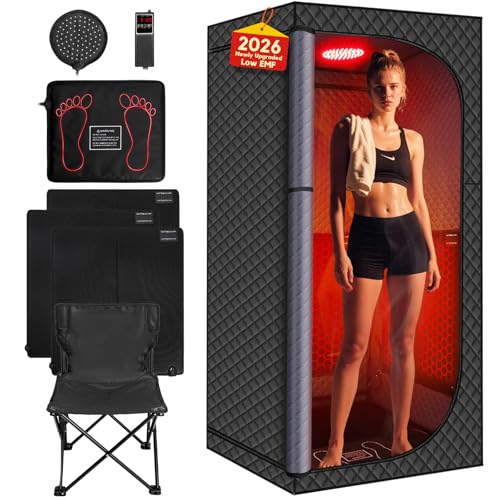 MIXC Upgraded Low EMF Infrared Sauna Box
- 【Your Personal At-Home Wellness Retreat】 Unwind after a…
- 【Far Infrared Sauna: Safe, Efficient & Easy to…
- 【SAFE AND SECURE】 Easily adjust temperature via the…
As an Amazon Associate we earn from qualifying purchases at no extra cost to you.
| Sauna type | Typical capacity and footprint | Heater coverage | Typical temperature range | Assembly and electrical needs | Common materials |
|---|---|---|---|---|---|
| Compact one-person cabin | 1 person; about 3 × 3 ft floor area | Usually 4–6 panels across the back, sides, and sometimes calves | About 100–150°F | Often modular panel assembly; many models use a dedicated 120 V, 15 A circuit | Hemlock, basswood, or other softwood; carbon or ceramic-based heaters |
| Two-person cabin | 1–2 people; about 4 × 4 ft | Typically 6–10 panels; coverage depends on seating position and panel layout | About 100–150°F | More panels and heavier sections; some models need a dedicated 120 V circuit, others require 240 V | Hemlock or basswood; carbon or mixed carbon-and-ceramic panels |
| Three- or four-person cabin | 3–4 people; roughly 5 × 6 ft or larger | Often 8–12 or more panels, though panel count alone does not indicate even coverage | About 100–150°F | More involved assembly; commonly requires a dedicated 240 V circuit | Softwood cabin panels; carbon, ceramic, or mixed heaters |
| Portable infrared enclosure | Usually 1 person; about 2 × 3 ft plus room to enter | Panels or heating elements near the back and sides; coverage is more limited | Often about 100–140°F | Usually folds or assembles without cabin-style joinery; check voltage, amperage, and outlet instructions | Fabric exterior with insulated lining and embedded heating elements |
These temperature ranges describe typical product settings, not a recommended exposure for every person. A displayed maximum also does not tell you how long the cabin takes to reach it, how evenly it heats, or whether the temperature is measured at the bench, wall, or control sensor.
Good choices by situation
| Your situation | A sensible choice | Why | Check before purchase |
|---|---|---|---|
| Limited floor space or uncertain routine | Portable one-person enclosure | Smaller commitment and easier storage than a wooden cabin | Chair support, cleaning instructions, cord placement, and whether the enclosure fits your seated height |
| Regular solo use and a permanent spare corner | Compact one-person cabin | More stable seating and a dedicated interior than a fabric enclosure | Exterior clearance, door swing, assembly access, and outlet circuit |
| Two people will use it at once | Two-person cabin, after checking interior bench width | Capacity labels may count close seating rather than comfortable shoulder room | Usable bench dimensions and heater placement for both seated users |
| Frequent shared use and ample space | Larger cabin, provided a suitable circuit is available | More room can improve comfort, but increases cost, heat-up time, and installation demands | Dedicated 240 V requirements, delivery route, floor loading, and service access |
How to judge heater coverage, not just panel count
Heaters should be positioned so that seated users receive reasonably distributed warmth across the back and sides, with lower-body coverage if that matters to you. Ask for a panel-location diagram rather than relying on a headline such as “full-body heating.” More panels do not automatically mean better coverage: panel size, placement, control zones, cabin dimensions, and how many people sit inside all matter.
Carbon heaters are commonly marketed for broad, lower-temperature radiant heating; ceramic elements are often described as reaching higher surface temperatures. Those labels alone do not establish greater comfort or health benefit. Look for clear information on heater locations, control settings, warranty coverage, and replacement parts.
Electrical and assembly checks that can prevent a costly mistake
- Confirm the circuit: A plug that fits an outlet does not prove the circuit is suitable. Check the manual for voltage, amperage, plug type, and whether the sauna must have a dedicated circuit. Ask a qualified electrician if the requirements are unclear or a new circuit is needed.
- Measure the whole installation: Record the exterior width, depth, and height, plus required wall clearance and door swing. Measure the route through hallways and doorways too; cabin panels may arrive in large sections.
- Plan assembly: Modular cabins may still be heavy or awkward to align. Check whether two adults are recommended, whether special tools are required, and whether delivery includes moving panels indoors.
- Check the materials: Ask what wood is used, how interior surfaces are finished, and whether adhesives or coatings are present. A “low-EMF” or “non-toxic” label is not a substitute for product documentation.
- Leave room to maintain it: Keep access to controls, wiring connections, and service panels. Follow the maker’s instructions for ventilation and cleaning rather than sealing or modifying the cabin.
What the evidence says about “detoxification”
The body handles waste through organs including the liver and kidneys. Sweat is mostly water and salt, with small amounts of other substances. Research on saunas has explored effects such as relaxation and cardiovascular responses, but that does not prove that far infrared sessions meaningfully remove toxins or treat a health condition. “Detox” is often used in marketing without identifying a substance, measuring its removal, or showing a health outcome.
Use a sauna, if appropriate for you, as a comfort or relaxation amenity—not as a replacement for medical care, prescribed treatment, or evaluation of possible exposure to a harmful substance. If you are pregnant, have a medical condition, take medication that affects heat tolerance, or have been advised to limit heat exposure, consult a healthcare professional before use. Stop if you feel faint, unwell, or unusually overheated, and follow the manufacturer’s time and temperature guidance.
Ownership realities: the details that affect value
For a simple cost-per-use estimate, divide the purchase price by the number of sessions you realistically expect. For example, a $2,000 cabin used three times a week for three years would provide about 468 sessions, or roughly $4.27 per session before electricity, delivery, and maintenance. At once a week, the same cabin over three years works out to about $12.82 per session. This is a planning estimate, not a promise of lifespan or energy cost.
Before buying, check the warranty term for heaters separately from the wood enclosure and controls. Electrical components, door seals, hinges, and control panels are more likely to need attention than the cabin’s basic wood panels. Sweat can leave residue on benches, so use a towel and clean surfaces using the manufacturer’s recommended method; harsh cleaners can damage finishes. Avoid blocking ventilation, placing wet items against heaters, or assuming a household extension cord is safe unless the manual explicitly permits it.
For most buyers, the best choice is the smallest cabin that comfortably fits its regular users and works with an existing or feasible electrical circuit. Prioritize an understandable heater layout, documented materials, practical assembly instructions, and responsive service over detoxification promises.









