Key takeaways
- Pro: Generates genuine conversation and laughter without requiring strategy skill or reading ability.
- Pro: Scales well from three players up through large family gatherings.
- Con: Replayability drops once everyone memorizes each other’s favorite colors.
What's inside
The hardest part of choosing a board game for family night is not finding something fun for kids or fun for adults — it is finding something fun for everyone at the same table. A game that bores a ten-year-old will bore their parent faster. A game that requires a strategy manual will stall before the first round finishes. The best family games share a specific profile: rules simple enough for a seven-year-old to pick up in two minutes, enough depth that adults do not mind playing it for the fourth time this month, and a play time that lands before the bedtime argument starts.
What separates a solid family game from a shelf ornament comes down to whether it creates shared moments without requiring shared experience levels. Price matters too, but most games in this bracket cost less than a single family movie ticket. We compared these eight options on published specs, real owner feedback, and price to identify which ones actually make it back to the table for round two.
As an Amazon Associate we earn from qualifying purchases at no extra cost to you. Product prices and availability are accurate as of the date shown and are subject to change.


Quick Picks
| Product | Best for | Price |
|---|---|---|
| Do You Really Know Your Family? | Conversation and connection | $19.82 |
| Sorry! | Young children (6+) | $8.98 |
| Trouble | Preschoolers (5+) | $9.84 |
| Yahtzee | Dice strategy and scoring | $8.88 |
| UNO | Travel, large groups, parties | $11.65 |
| TAPPLE | Timed word challenges | $19.98 |
| WHAT DO YOU MEME? Family Edition | Tweens and teens | $17.17 |
| Twister | Active indoor play | $16.99 |
How We Picked
We filtered this list on four criteria: the minimum age requirement (a game that excludes the youngest player defeats the purpose), rule complexity (how many minutes until the first actual turn happens), replayability (does the game offer variety or is it solved by round three?), and player count flexibility (a game locked to exactly two players is rarely the right call for a family). Price was a tiebreaker, not a filter, because the most expensive game on this list is still under twenty dollars.
The 8 Best Board Games For Family Night in 2026
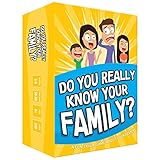
Do You Really Know Your Family?
This game turns a family night into a low-stakes interview. Players answer questions about each other’s preferences, habits, and opinions, scoring points when they match the real answer. It is best for families with mixed ages who want something cooperative-feeling rather than competitive.
- Pro: Generates genuine conversation and laughter without requiring strategy skill or reading ability.
- Pro: Scales well from three players up through large family gatherings.
- Con: Replayability drops once everyone memorizes each other’s favorite colors.
Skip it if your family prefers games with physical interaction or board movement — this is a talking game first.
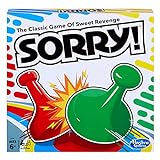
Sorry!
The classic Hasbro push-and-slam race game where players move four pawns home using a deck of cards that can send opponents back to start. It is ideal for families with children six and up who want a simple competitive structure with built-in chaos.
- Pro: Rules are taught in under two minutes; a five-year-old who cannot read still enjoys the card mechanic.
- Pro: At under nine dollars, it is the cheapest entry point on this list.
- Con: The “Sorry” knockback mechanic creates real frustration in sensitive younger players.
Skip it if your household treats losing badly as a teachable moment that gets exhausting — the randomness here generates conflict regularly.
Trouble
Trouble pairs a die-popping bubble mechanism with a short race track for four pawns per player. Designed for ages five and up with two to four players, it is the most accessible game on this list for preschool families.
- Pro: The pop-o-matic dice dispenser adds physical fun beyond the board itself for young children.
- Pro: Turns resolve quickly, keeping attention spans intact for players at the lower age bound.
- Con: The first player with a strong dice streak wins with very little counterplay for opponents.
Skip it if your family includes players eight and older who will find the lack of strategy unsatisfying within two rounds.
Yahtzee
Yahtzee is a dice game where players roll five dice and attempt to fill thirteen scoring categories across thirteen turns. Hasbro markets it for ages eight and up with two or more players, and it functions as both a family game and a solo scoring exercise.
- Pro: The fixed thirteen-round structure guarantees a natural endpoint, preventing the “let’s play one more” spiral.
- Pro: Strategy layers emerge over time as players learn to optimize category placement.
- Con: Younger players who cannot yet do arithmetic will need adult help with the scorepad.
Skip it if your family resists math-heavy components or if your youngest player is under seven.
UNO
Mattel’s card-matching game where players shed cards by matching color or number, with action cards that reverse, skip, and pile on penalties. The Amazon-exclusive edition adds a color-blind accessible deck and customizable blank cards. It works from two players up through eight or more.
- Pro: Compact and travel-proof — it fits in a coat pocket and requires zero table setup.
- Pro: The blank-card customization lets families invent house rules, extending shelf life dramatically.
- Con: Draw-four stacking can leave a younger player stuck holding ten-plus cards in a single turn.
Skip it if you have already established strict UNO table rules and need a board-game format with more visual structure.
TAPPLE
USAOPOLY’s TAPPLE is a timed word game using a push-down grid and a timer button. Players race against the clock to shout out words matching a letter combination on the grid, then pass the timer to the next player. It is marketed as a family game and plays well from three players up.
- Pro: The timer creates urgency that naturally limits each turn to seconds, keeping energy high even with short attention spans.
- Pro: Word categories are broad enough that a strong vocabulary does not automatically dominate.
- Con: The timer unit is small and easy to lose, which kills the game entirely.
Skip it if your family prefers cooperative play or strategic thinking over fast verbal recall.
WHAT DO YOU MEME? Family Edition
Relatable’s Family Edition adapts the adult meme game into an age-appropriate format for tweens and teens. Players receive a meme card with a missing text box and compete to fill it, with one player judging the best answer each round. At seventeen dollars and change, it is priced for families wanting humor with a lighter educational angle.
- Pro: The creative prompt structure encourages writing and humor skills that transfer beyond game night.
- Pro: Teens who think board games are “for little kids” often engage genuinely with this one.
- Con: The judge mechanic introduces subjective scoring that can create sibling rivalry over “unfair” choices.
Skip it if your youngest players are under seven, as the reading and creative-writing demands will exclude them.
Twister
Hasbro’s physical party game uses a printed mat with colored circles and a spinner that assigns limbs to positions. Players hold the resulting pose until they fall. It is designed for two or more players, ages six and up, and works indoors or outdoors.
- Pro: Zero reading, zero strategy, zero scorekeeping — it levels the field completely between a six-year-old and a thirty-year-old.
- Pro: The physical comedy it produces generates the most laughter-per-minute of anything on this list.
- Con: The mat takes up significant floor space and is difficult to store in apartments.
Skip it if your family includes members with mobility limitations or if you have very limited floor space.
Buying Guide
Match the Age Floor to Your Youngest Player
The single most important spec is the minimum age. Trouble works at five. Sorry! and Twister work at six. Yahtzee starts at eight. If your family spans four to twelve years old, a game with an eight-year floor will exclude your youngest for years. A game with a five-year floor may feel too simple for your oldest, but it is far easier to adapt a young game upward than to force a complex game downward.
Check the Play Time Before You Need a Timer
Families with young children should target games that resolve in under twenty minutes. Sorry!, TAPPLE, and Twister all hit that window naturally. Yahtzee takes a fixed thirteen rounds and runs longer. If your evening has a hard cutoff (dinner, bath, bedtime), the game must respect it without someone suggesting “just one more round” as a power move.
Player Count Flexibility Matters More Than You Think
Few families play games in a fixed configuration. One child is at a friend’s house; a grandparent joins; a neighbor kid shows up. A game rated for 2-4 players (Trouble) handles a three-person night but stalls at five. UNO and TAPPLE scale upward more gracefully. Look for a stated player range of at least 2-4, with some headroom beyond that, unless your family reliably sits at the exact same number every time.
Our Verdict
The top pick for most families is UNO. It covers the widest player count, costs under twelve dollars, fits in any bag, and has no age floor issue above five. For the budget slot, Sorry! at eight dollars and ninety-eight cents delivers the most traditional “board game” experience per dollar on this list. And if your family skews toward tweens and teens who resist classic board games, WHAT DO YOU MEME? Family Edition wins because it speaks their language without requiring a single rule explanation beyond “make the meme funny.”
FAQ
How many games do I need for a good family rotation?
Two to three covers most families. Pick one short game for weeknights and one longer or more strategic game for weekends. Adding a physical game like Twister rounds out the variety so evenings do not feel repetitive.
Are these games appropriate for a four-year-old?
Only Trouble lists ages five and up, and even that is a stretch for a four-year-old’s attention and motor skills. Most family game nights work best when the youngest is at least five or six. For younger children, the game itself becomes less about rules and more about shared experience.
Can I play these with more players than listed?
You can physically play any of them with larger groups, but the experience degrades. Turn order slows, downtime increases, and younger players disengage. For true large-group play, UNO and TAPPLE handle the overflow best because their per-turn time is shortest.
Is the Amazon-exclusive UNO worth the premium over the standard deck?
The color-blind accessible deck is a genuine functional upgrade if anyone in your family has a color vision deficiency. The blank customizable cards are a minor bonus. For households without that accessibility need, the standard version delivers the same game, though the price gap is small enough that the upgrade rarely hurts.