Key takeaways
- Under 1,000 sheets a week: entry desktop or hand-fed folders.
- Roughly 1,000 to 5,000 sheets a week: mid-range motorized desktop models.
- 5,000 to 10,000 sheets a week: robust automatic folders such as the Formax FD 300 per one outlet.
- Daily mailroom use: high-capacity models such as the Martin Yale 1217A and Formax FD 38Xi.
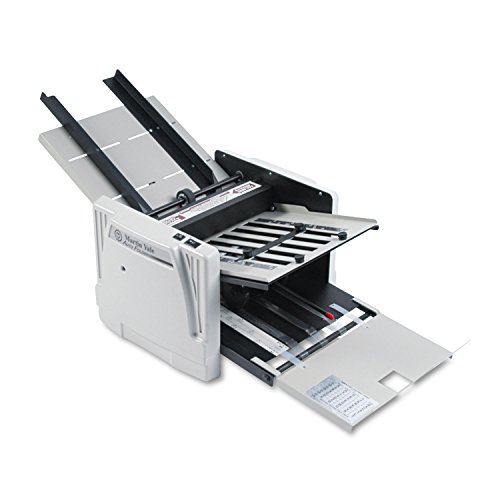
For a small office folding under about 1,000 sheets a week, an entry desktop folder such as the Martin Yale P7200 or P7500 is usually enough, a mid-volume office will look at the Martin Yale 1611 or Formax FD 300, and a mailroom with daily high-volume runs belongs in the Martin Yale 1217A or Formax FD 38Xi class. The deciding factors are weekly sheet volume, the fold types you need, paper weight and how much noise and setup time you can accept.
Our top picks


As an Amazon Associate we earn from qualifying purchases at no extra cost to you.
Start with volume, not features
Review sites that cover folders sort models by weekly workload, and the sorting is useful. Very low volume, such as monthly invoices or a few hundred letters, may be handled by a hand-fed or semi-manual model. Weekly runs of a few thousand sheets justify a motorized desktop unit with a feed tray. Daily mailings of many thousands call for a heavier-duty folder with a larger hopper. Buying too small leads to jams and constant refilling, while buying too large wastes space and budget.
Rough workload bands (from reviewer guidance)
- Under 1,000 sheets a week: entry desktop or hand-fed folders.
- Roughly 1,000 to 5,000 sheets a week: mid-range motorized desktop models.
- 5,000 to 10,000 sheets a week: robust automatic folders such as the Formax FD 300 per one outlet.
- Daily mailroom use: high-capacity models such as the Martin Yale 1217A and Formax FD 38Xi.
These bands are guidance from review sites, not manufacturer guarantees. Always check the duty cycle in the manual.
At a glance: popular office folders
| Model | Best for | Stated specs (from reviewers and makers’ listings) | Limits |
|---|---|---|---|
| Martin Yale 400 / 400E | Very light use, under about 1,000 sheets a week | Hand-fed design | Slower and less automated. |
| Martin Yale P7200 | Typical small-office workloads | Named as best value for small offices by one reviewer | Lower capacity than larger models. |
| Martin Yale P7500 | Small offices wanting more fold types | Listed at around 4,000 sheets per hour, a 50-sheet tray and 4 fold types | Small tray; not for heavy runs. |
| Martin Yale 1611 | Best all-round desktop per one guide | Listed at about 9,000 sheets per hour | Larger footprint; higher cost tier. |
| Martin Yale 1217A | High volume and mailrooms | Listed at about 10,300 sheets per hour, 7 fold types and a 250-sheet feed | Premium tier; heavy and bulky. |
| Formax FD 300 | Offices folding 5,000 to 10,000 sheets a week per one outlet | Desktop automatic folder | Check maker spec for fold types. |
| Formax FD 38Xi | Heavy daily users per one guide | High-capacity automatic folder | Premium tier and floor space. |
| United Office F100 | Budget buyers who want a bigger hopper | Listed with a 200-sheet hopper and speeds up to 156 sheets per minute | Check build quality reports before buying. |
Speeds and capacities come from reviewer roundups and maker listings and can vary by paper weight and fold type. Many of these roundups are affiliate-driven, so compare them against maker specifications.
Fold types you may need
Most office folders handle several standard folds. Business letters typically use a letter (tri-fold, also called C-fold) or a Z fold. Other common folds include half fold, double parallel and the accordion. Entry models offer fewer fold types, while larger machines such as the Martin Yale 1217A list up to seven. If you mail inserts that must fit a particular envelope, confirm the fold length is adjustable and what range the maker states.
Paper size and weight
Standard folders handle letter and legal sizes, and many handle A4. Check the minimum and maximum paper weight in the manual, because heavy stock or glossy paper may jam on a machine designed for standard copy paper. Mixed stock, curled paper and static are the usual causes of misfeeds. Fan the stack and keep paper stored flat in a dry room.
Features that matter day to day
- Feed tray capacity: a 50-sheet tray means frequent reloading, while a 200 to 250-sheet feed lets you walk away.
- Setup speed: adjustable plates and quick-change fold settings save time, particularly if you switch between letters and flyers.
- Noise: motorized units are noisy, so consider placing larger machines away from open workspaces.
- Counters and sheet counting: useful for batches, and some units have batch counters. Confirm in the specification.
- Footprint: desktop models fit on a table, while larger units may need a dedicated stand.
- Support and parts: look at whether the maker or a local dealer offers service, because rollers wear.
Safety and maintenance
Keep fingers and loose clothing clear of rollers and follow the maker’s safety instructions. Unplug the machine before clearing jams or cleaning. Roller wear and dust cause most reliability problems, so clean rollers as the manual instructs and replace them when feeding slows. Check the rated duty cycle so you do not run the motor beyond what the maker allows.
Pick X if you…
| If you… | Pick | Reason |
|---|---|---|
| Fold only occasionally, a few hundred sheets a week | Martin Yale 400 or P7200 | Low cost, simple operation |
| Fold under 1,000 pieces weekly and want variety | Martin Yale P7500 | 4 fold types, compact |
| Want a general-purpose office workhorse | Martin Yale 1611 | Balance of speed and fold options |
| Run 5,000 to 10,000 sheets a week | Formax FD 300 | Matches that volume band |
| Run a daily mailroom | Martin Yale 1217A or Formax FD 38Xi | Large feed, high speed |
| Need a big hopper at a low price | United Office F100 | 200-sheet hopper |
Budget tiers
Budget: the Martin Yale 400 and United Office F100. Mid-range: Martin Yale P7200 and P7500, and the Formax FD 300. Premium: Martin Yale 1611 and 1217A, and Formax FD 38Xi. Ongoing costs include replacement rollers, service and the time lost to jams.
Alternatives
- Outsourced mailing services: useful for large but infrequent campaigns.
- Folding inserters or mailing systems: combine folding, inserting and sealing for offices that mail daily.
- Digital delivery: for invoices and statements, electronic delivery removes folding altogether.
- Manual folding tools: a simple bone folder or jig suits very small jobs.
Setup and workflow tips
A folder is only as fast as the way it is fed. Keep stock in a cool, dry place, and fan stacks before loading. Run a small test batch whenever you change paper type, weight or fold, because fold accuracy depends on guide settings. Use a stand or a dedicated table so the machine does not vibrate across a desk. Plan where folded output will go, since a machine folding thousands of sheets an hour can bury a small catch tray. If you pair the folder with an envelope stuffer or inserter, confirm that the fold size matches the envelope the maker lists. For privacy-sensitive documents such as payroll or statements, think about who can access the machine and the output tray. Finally, schedule a short weekly check of rollers and feed paths, and keep a spare set of rollers if you rely on the machine for time-critical mailings.
Total cost of ownership
The purchase tier is only part of the cost. Consumables such as rollers, service visits, power use and staff time all count. A cheaper machine that jams often can cost more in lost time than a higher-tier unit that runs smoothly. Ask the dealer about warranty length, on-site service and parts availability, and read the manual for stated duty cycles before committing.
It is also worth asking who will operate the machine. A model with clear markings for fold settings and a simple control panel lets any staff member run a batch, while a complicated unit tends to be used only by the one person who learned it. Consider training time, written setup cards taped to the machine, and a short list of paper types your office uses regularly with the settings that suit each. Those small habits reduce waste, because most spoiled mailings come from setup errors rather than machine faults.
Frequently Asked Questions
How do I choose a paper folder for my office?
Begin with your weekly sheet count, then match fold types, paper size and noise tolerance. Small offices rarely need the highest-volume models, and larger offices should ensure a duty cycle that fits their workload.
Are folding machines worth it for small offices?
If you fold more than a few hundred letters at a time, a machine saves time and gives consistent folds. For occasional use, hand folding or an outsourced service may be cheaper. Reviewers point to entry models for under about 1,000 sheets a week.
What causes paper jams in a folder?
Misfeeds usually come from curled or damp paper, static, unsuitable weight, wrong guide settings or worn rollers. Fanning the stack, using flat dry paper and cleaning rollers per the manual reduce the problem.
Can a folder handle different paper sizes?
Most handle letter, legal and often A4 with adjustable guides. Check the minimum and maximum sizes and weights in the manual before running unusual stock.
How loud are paper folding machines?
Motorized models are noticeably noisy, and larger ones more so. If you work in an open office, place the machine in a mailroom or a quieter corner.
Do I need a dealer or service plan?
For high-volume machines, local service and spare parts matter because rollers wear. For entry models, many offices simply replace worn parts or the unit.
More from Amazon
Programs that pair well with the guide above. Offers and eligibility are set by Amazon and may change.
Set up recurring deliveries of everyday items on eligible products. Terms and savings are set by Amazon.
Explore Subscribe & SaveCollect the home and kitchen items you want in one registry that guests can shop from.
Create a wedding registryFree shipping on eligible items, Prime Video and more. Eligible new members can start with a free trial.
Start a Prime free trialAudiobooks and podcasts to listen to on the go. Eligible new members can start with a free trial.
Try Audible freeAs an Amazon Associate we earn from qualifying purchases.