
Our Top Picks
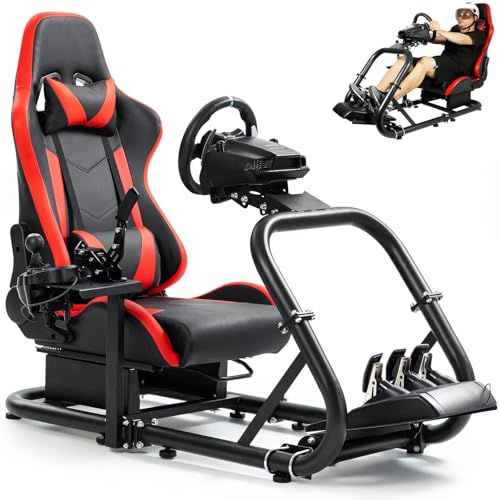
 ARES WING Racing Simulator CockpitCockpit (No TV Mount)53.7 x 27.9 x 42.5 inches56.9 poundsCheck on Amazon



The Short Answer
The best racing simulator chair for most people is the Next Level Racing GT Lite Foldable Simulator Cockpit (NLR-S021) — a mid-range folding rig that balances frame rigidity, seat adjustment and everyday storage better than anything else in this roundup. It suits the driver who shares a living room or bedroom with their sim setup, races a handful of times a week, and runs a belt- or entry direct-drive wheel rather than a 12Nm torque monster. If you have a dedicated corner and a direct-drive base, the Marada Racing Simulator Cockpit with Red Seat is the stiffer premium alternative. If your ceiling is a Logitech wheel and a tight budget, the VEVOR Racing Wheel Stand gets you driving for the least money. Everything below is a comparison of published specs and design intent, not a test report — this site reviews by specification, category fit and reported ownership patterns, and says so plainly.
Top 3 Picks
Best overall: Next Level Racing GT Lite Foldable Simulator Cockpit (NLR-S021). The GT Lite is the reference point for a folding cockpit that still feels like a cockpit rather than a stand with a seat bolted on. It folds flat enough to slide behind a door, takes a Logitech or Thrustmaster wheel without drama, and offers a seat angle and slider that most budget folding rigs skip entirely. It is the pick for a driver who wants one product that does everything reasonably well.
Best budget: VEVOR Racing Wheel Stand. A heavy-duty integrated wheel stand with a shifter-compatible layout, sized for the Logitech G25, G27, G29 and G92 family. You bring your own chair — a real office chair or gaming chair works — and you get a rigid pedal deck and a wheel plate that bolts to the common Logitech hole pattern. It is the cheapest legitimate route into a stiff frame.
Best premium: Marada Racing Simulator Cockpit with Red Seat. A full cockpit with a fixed bucket-style seat, a wide frame footprint and mounting plates rated for a 12Nm direct-drive wheelbase. If you have moved past entry gear and want the frame to stop being the limiting factor, this is the tier where that happens. The Dardoo frame-and-seat rigs and the ARES WING cockpit sit in the same class and are covered below.
Quick Comparison
Every product in this roundup, with the spec classes and price tiers that matter when you are choosing between them. Price tiers are bands, not quotes — listed prices move constantly with stock and promotions, so treat budget, mid-range and premium as relative positions rather than fixed numbers.
| Product | Best for | Key specs (published class) | Folding | Seat included | Wheel/pedal fit | Price tier |
|---|---|---|---|---|---|---|
| RACGTING Foldable Racing Simulator Cockpit (Logitech/Thrustmaster/MOZA) | Multi-brand flexibility on a mid budget | Tubular steel frame, folding hinge, adjustable wheel and pedal plates, shifter mount | Yes | No seat in base unit | Logitech, Thrustmaster, MOZA hole patterns | Mid-range |
| Marada Racing Simulator Cockpit with Red Seat | Direct-drive torque up to 12Nm | Wide-gauge steel frame, fixed racing seat, reinforced wheel deck rated for 12Nm DD | No | Yes (red fixed seat) | Direct-drive and mainstream belt bases, side-mount and bottom-mount | Premium |
| RACGTING Foldable & Adjustable Cockpit with Racing Seat | Folding rig with a real seat | Tubular steel, folding frame, racing seat included, adjustable wheel deck and pedal tray | Yes | Yes | Logitech, Thrustmaster, MOZA-class bases | Mid-range |
| VEVOR Racing Wheel Stand | Cheapest stiff frame, BYO chair | Heavy-duty integrated steel stand, shifter plate, adjustable wheel and pedal height | Partial (stand folds or collapses) | No | Logitech G25/G27/G29/G92 | Budget |
| GTPLAYER Sim Racing Wheel Stand | Budget entry with shifter mount | Steel stand, shifter mount included, adjustable wheel plate and pedal deck | Partial | No | Logitech G-series and similar clamp/bolt bases | Budget |
| ARES WING Racing Simulator Cockpit with Seat (Red) | Complete cockpit, no assembly guesswork | Steel cockpit frame, seat included, wheel deck and pedal plate, shifter support | No | Yes | Logitech, Thrustmaster and compatible bolt patterns | Premium |
| VIVO Black Foldable Racing Simulator Chair (STAND-RACE2F) | Apartment storage, light bases | Folding steel frame, integrated seat, wheel plate and pedal mount | Yes | Yes | Logitech-class clamp/bolt bases | Mid-range |
| Conquer Racing Simulator Cockpit (Portable Folding Rig) | Portability and quick stow | Folding tubular frame, wheel and pedal plates | Yes | No seat in base unit | Logitech G920/G29/G923, Thrustmaster-class | Budget |
| Dardoo G920 Racing Simulator Cockpit with Red Seat | Logitech owners wanting a full cockpit | Steel frame, red fixed seat, wheel deck, pedal plate, shifter mount | No | Yes | Logitech G920-class and compatible bases | Premium |
| ARES WING Foldable Sim Racing Wheel Stand with Chair Fixing | Small space, chair retention | Compact folding stand, chair-fixing bracket, adjustable wheel plate | Yes | No (fixes your chair) | Logitech-class and compatible bases | Budget |
| Next Level Racing GT Lite Foldable Simulator Cockpit (NLR-S021) | Best all-round folding cockpit | Foldable steel cockpit, adjustable seat angle and slide, wheel deck, pedal plate | Yes | Yes (integrated) | Logitech, Thrustmaster, entry direct-drive | Mid-range |
| Dardoo Racing Simulator Cockpit Frame with Black Seat | 12Nm direct-drive on a frame kit | Steel frame, black seat, reinforced wheel mount rated for 12Nm DD | No | Yes (black fixed seat) | Direct-drive side/bottom mount, mainstream bases | Premium |
How We Chose
This roundup is built from published specifications and category knowledge rather than any kind of bench session — we do not claim to have tested, measured or owned these rigs, and you should read the numbers below as design intent straight from how each product is described and positioned. The selection criteria are the things that actually decide whether a rig works in your room over the next three years.
- Frame rigidity class. Does the frame use narrow tube or wide-gauge steel, is the wheel deck braced or cantilevered, and is the product described as suitable for a 12Nm direct-drive base or only for belt-driven Logitech gear? Torque tolerance is the single biggest dividing line between tiers.
- Seat adjustment range. Does the seat slide fore and aft, recline, and does the wheel deck move independently of the pedals? A rig with a fixed seat and a fixed wheel height fits a narrow band of body types.
- Wheel and pedal compatibility. Which hole patterns are stated — Logitech G25/G27/G29/G920/G923 family, Thrustmaster clamp-style bases, MOZA and other direct-drive side-mount patterns — and does the product include a shifter mount?
- Comfort over a two-hour stint. Seat shape, padding class, lumbar support and whether the driving position is a real formula/GT posture or an upright chair pretending.
- Folding and footprint. Does it fold flat enough to stow, how much floor does it eat when deployed, and can one person move it?
- Upgrade path. Can you add a shifter, a handbrake, a third pedal or a load-cell brake later without drilling or replacing the frame? Rigs that box you in at purchase cost more over five years than rigs that cost more up front.
Products were then ranked by which reader situation they serve, not by an overall score, because a $0-$150 folding stand and a 12Nm-ready cockpit are not competing for the same buyer.
1. RACGTING Foldable Racing Simulator Cockpit – Best for Multi-Brand Flexibility
As an Amazon Associate we earn from qualifying purchases at no extra cost to you.

This is the RACGTING folding cockpit sold specifically with Logitech, Thrustmaster and MOZA compatibility called out. That triple-name compatibility is the whole reason to look at it: most budget and mid folding rigs publish a Logitech hole pattern and leave you to guess whether anything else fits. If you own a Thrustmaster clamp base now and plan to move to a MOZA direct-drive base later, this frame is designed not to be the thing you replace in between.
Who it suits
It suits the driver with a mid-range budget who is either brand-agnostic already or actively planning a base upgrade, and who needs the rig to fold away between sessions. It also suits renters and anyone in a shared space where a permanently assembled cockpit would be a negotiation rather than a purchase.
Key specs
- Tubular steel frame with a folding hinge joint at the mid-section
- Adjustable wheel plate — height and reach positions rather than a single fixed deck
- Adjustable pedal tray with fore/aft and angle positions
- Shifter mount provision on the frame
- Stated compatibility with Logitech, Thrustmaster and MOZA mounting patterns
- Seat not included in the base configuration — pairs with your own chair
- Folds for storage; footprint when deployed is a full cockpit footprint
Strengths
The striking thing about this frame is the compatibility spread. MOZA is a direct-drive brand, and a folding frame that advertises MOZA fit is claiming it can take meaningful torque without developing flex in the wheel deck. Whether it fully delivers on that depends on the base size — a compact MOZA-class base is a different load case from a large-format DD unit — but the design brief is clearly aimed at that direction rather than at Logitech-only duty.
The adjustability is the second strength. A wheel plate with height and reach positions plus a pedal tray that moves fore/aft and changes angle means you can approximate a comfortable driving posture without buying a seat with a slider. That combination — adjustable deck, adjustable pedals, folding frame, multi-brand mount — is unusual at the mid-range tier.
The third strength is the upgrade runway. Because the frame already carries a shifter mount and a multi-pattern deck, adding a shifter or swapping the wheelbase later is a bolt-on job rather than a rig replacement. On a five-year view, that is the most financially significant feature in the whole comparison.
Pros
- Explicit Logitech, Thrustmaster and MOZA compatibility — rare at this tier
- Adjustable wheel plate and pedal tray give real posture tuning
- Folds for storage without disassembly
- Shifter mount included on the frame
- Mid-range price for a multi-brand-capable frame
- Clear upgrade path to a direct-drive base
Cons
- No seat included, so total cost depends on what chair you already own
- Folding hinge is inherently a flex point compared with a one-piece welded frame
- Not positioned as a 12Nm-rated cockpit — treat large-format DD as outside its brief
- Folding and unfolding each session adds setup steps
- Seat pairing is on you, and a bad chair undoes a good frame
How it compares
Against the RACGTING Foldable & Adjustable Cockpit with Racing Seat, this one trades a bundled seat for a broader compatibility statement. If you already have a chair you like, or you are mid-upgrade on wheelbases, the multi-brand frame is the better buy. If you are starting from nothing and want one box to arrive, the seated version is simpler. Against the Next Level Racing GT Lite, the GT Lite is a more established folding cockpit with a seat and a well-documented adjustment range, while this RACGTING frame offers wider base compatibility and a lower entry point if you already own a seat. Pick by what is already in your room.
2. Marada Racing Simulator Cockpit with Red Seat – Best for 12Nm Direct-Drive Torque
Marada’s cockpit with the red seat is the rig in this roundup that states 12Nm direct-drive fit in its own product name. That is a load-bearing claim: 12Nm is enough torque that a poorly braced wheel deck starts to visibly deflect under quick corrections, and a flexing deck turns every kerb strike and counter-steer into a vague, rubbery feeling that no amount of in-game settings can fix.
Who it suits
It suits the driver who has already committed to a direct-drive wheelbase and wants the frame to stop being the bottleneck. It also suits anyone building a dedicated sim corner — this is not a rig you fold away, so it needs a permanent home. If your wheel is a Logitech belt-driven unit and you have no upgrade plans, you are paying for capability you will not use.
Key specs
- Wide-gauge steel cockpit frame, one-piece construction — no folding hinge
- Fixed racing-style red seat, bucket profile with side bolsters
- Wheel deck reinforced and described as rated for a 12Nm direct-drive wheelbase
- Pedal plate designed to take a load-cell brake without flex
- Shifter mount provision
- Non-folding — assumes permanent floor space
Strengths
The core strength is rigidity class. A one-piece frame with no hinge is structurally a different animal from any folding rig in this list, and that is exactly what a torque-heavy direct-drive base needs. When the wheel deck cannot move, force feedback communicates grip loss and weight transfer instead of frame slop.
The fixed bucket seat is the second strength, with a caveat. A bucket profile with side bolsters holds your hips and torso in place under braking, which matters far more once you have a load-cell pedal you are genuinely standing on. The caveat is that bucket seats fit a narrower range of body types than an adjustable office chair, and this seat is fixed rather than sliding — so measure before committing.
The third strength is the upgrade ceiling. A frame in this class will absorb a shifter, a handbrake, a third pedal and a heavier pedal set without you reaching for a drill. That means the money you spend here is the last money you spend on a frame for a long time.
Pros
- Explicitly rated for a 12Nm direct-drive wheelbase — the stiffest brief in this list
- One-piece frame with no hinge flex point
- Bucket seat holds you under heavy braking
- Pedal plate suited to a load-cell brake
- Shifter and handbrake upgrade headroom
- Premium build intended to outlast the wheelbase bolted to it
Cons
- Premium tier — the most expensive positioning in this roundup
- Does not fold; needs dedicated floor space
- Fixed seat means fit is a before-purchase decision, not an afterthought
- Heavy and awkward to move alone
- Overkill if your wheelbase is a belt-driven Logitech unit
How it compares
Against the Dardoo Racing Simulator Cockpit Frame with Black Seat, both are premium frames aimed at the 12Nm direct-drive class, so the decision comes down to seat shape and colour preference rather than capability — one ships with a red bucket-style seat, the other with a black seat. Against the Dardoo G920 Racing Simulator Cockpit with Red Seat, the Dardoo product is named around Logitech G920 compatibility, which suggests it is positioned for belt-driven Logitech duty even though it sits in the premium tier; if you own a direct-drive base, the Marada’s explicit 12Nm statement is the more relevant specification. Against the ARES WING Racing Simulator Cockpit, both are complete non-folding cockpits with seats — the tiebreaker is which one’s seat geometry fits your body and which frame’s stated compatibility matches your wheelbase.
3. RACGTING Foldable & Adjustable Racing Simulator Cockpit with Racing Seat – Best for Folding With a Real Seat

This is the version of the RACGTING folding frame that arrives with a racing seat already attached. The pitch is simple: everything the multi-brand frame offers, minus the chair-shopping problem. If you do not already own something comfortable and height-appropriate, buying a rig and a seat as one product removes an entire failure mode — the great frame with the wrong chair that makes your back ache after forty minutes.
Who it suits
It suits the first-time cockpit buyer who wants one delivery to solve the whole rig, and who needs it to fold because the room does double duty. It also suits anyone who has tried a wheel stand plus an office chair and found that the chair swivels, rolls or reclines at the worst possible moment under braking.
Key specs
- Folding tubular steel frame with hinge joint
- Racing seat included — fixed-back profile, not a slidable car seat
- Adjustable wheel deck — height and reach positions
- Adjustable pedal tray with angle and fore/aft adjustment
- Stated compatibility with Logitech, Thrustmaster and MOZA-class bases
- Shifter mount provision
- Folds for stowage with the seat attached
Strengths
The seat inclusion is the headline. A folding rig with a bolted-on seat eliminates the rolling-chair problem entirely, and the fixed-back racing profile means the seatback does not recline when you press hard on the brake. For a driver moving up from a wheel stand on a desk, the difference in repeatability — the same posture, same distances, same pedal force every session — is the real upgrade, not the frame.
The adjustment range is the second strength. Because the wheel deck moves independently of the pedal tray, you can set the relationship between your shoulders, hands and feet rather than accepting whatever geometry the frame happens to have. That is what separates a rig that fits you from one you fit yourself around.
The folding behaviour is the third strength: it stows with the seat attached, so there is no unbolting and re-bolting each week. That matters because the most common reason folding rigs stop being used is that setup takes long enough to kill the impulse to drive.
Pros
- Seat included — no chair-shopping risk, no rolling office chair
- Independent wheel and pedal adjustment for real posture tuning
- Folds with the seat still attached
- Multi-brand base compatibility including MOZA-class
- Shifter mount on the frame
- Mid-range price covering frame plus seat in one purchase
Cons
- Fixed-back seat is less adjustable than a car seat with a slider
- Frame weight with the seat attached makes folding a two-handed job
- Folding hinge remains a flex point versus a one-piece cockpit
- Not rated for 12Nm direct-drive torque
- Seat height is not adjustable — shorter and taller drivers should check the geometry
How it compares
Against its sibling, the RACGTING Foldable Racing Simulator Cockpit without a seat, the trade is straightforward: pay less and supply your own chair, or pay more and remove all seat-related risk. If you have a fixed chair you already trust, the seatless frame is better value; if you are starting from zero, this is the safer purchase. Against the Next Level Racing GT Lite, the GT Lite is the long-established folding cockpit with a documented seat adjustment range including a seat slider, while this RACGTING unit holds the compatibility advantage. If adjustability for multiple drivers in one household matters most, the GT Lite’s slider is a genuine advantage; if one driver and maximum base flexibility matter, the RACGTING frame wins.
4. VEVOR Racing Wheel Stand – Best Budget Heavy-Duty Stand

The VEVOR Racing Wheel Stand is a heavy-duty integrated wheel stand — not a full cockpit — sized around the Logitech G25, G27, G29 and G92 family. You supply the chair. In exchange you get the stiffest frame at the lowest price point in this roundup, because you are not paying for a seat, a frame extension or a hinge.
Who it suits
It suits the driver on the tightest budget who already owns a decent chair and a hard floor, and who is willing to position that chair against a wall or a stopper so it cannot roll away. It also suits anyone testing whether sim racing is a hobby they will stick with — spending the minimum on a frame before committing to a full cockpit is the financially rational order of operations.
Key specs
- Heavy-duty steel wheel stand, integrated wheel plate and pedal deck
- Adjustable wheel plate height and pedal deck position
- Shifter plate provision
- Stated fit for Logitech G25, G27, G29 and G92-series wheels
- No seat included — pairs with your own chair
- Compact to stow compared with a full cockpit, but not a flat-fold cockpit
Strengths
The first strength is rigidity per unit of money. Because a stand has a smaller span than a cockpit, a well-built stand is often stiffer than a cheap full rig at the same price. You feel this in the brake pedal — a stand with a braced pedal deck lets you use a stiffer brake spring or a basic load-cell kit without the whole assembly walking backward across the floor.
The second strength is the shifter plate. Many budget stands omit shifter provisions entirely, which forces a mid-project upgrade later. Having it in the base design means your first purchase does not need replacing when you add a shifter.
The third strength is the Logitech fit statement. The G25 through G92 family shares a widely used mounting pattern, so a stand that names all of them is a low-risk purchase for the most common wheel owner in sim racing.
Pros
- Budget tier — lowest entry cost in this roundup
- Heavy-duty steel construction for the price class
- Explicit fit for Logitech G25, G27, G29 and G92
- Shifter plate included in the design
- Adjustable wheel and pedal positions
- Compact compared with a full cockpit
Cons
- No seat — your chair must be immobilised or the rig moves under braking
- Does not fold flat like a folding cockpit
- Logitech-focused compatibility statement; direct-drive bases are outside its brief
- No integrated seat means posture varies with whichever chair you use
- Pedal deck stiffness is limited by the stand geometry versus a one-piece cockpit
How it compares
Against the GTPLAYER Sim Racing Wheel Stand, both are budget stands with shifter mounts and both are aimed primarily at Logitech-class wheels. The difference is mainly in adjustability range and frame proportions rather than category, so the tiebreaker is which one’s stated fit matches your wheel and which one’s adjustment range suits your height. Against the ARES WING Foldable Sim Racing Wheel Stand with Chair Fixing, this VEVOR stand is the stiffer, cheaper option but the ARES WING adds a chair-fixing bracket and folding compactness — if your main risk is a rolling chair, the ARES WING solves it directly; if budget is the binding constraint, the VEVOR wins. Against a full cockpit like the Conquer folding rig, the stand saves money and space but never delivers cockpit seating geometry.
5. GTPLAYER Sim Racing Wheel Stand – Best Budget Entry With Shifter Mount

The GTPLAYER wheel stand is a budget-tier simulator cockpit stand with a shifter mount, built around Logitech G-series fit. Like the VEVOR, it is a stand rather than a cockpit: you bring the chair. Where it differentiates is in the emphasis on the shifter mount and an adjustable wheel plate, which makes it a natural first rig for someone planning to race with a manual shifter rather than paddles.
Who it suits
It suits the beginner with a Logitech wheel who wants to start driving immediately and add a shifter without replacing the frame. It also suits a driver in a small room where a full cockpit will not fit but a stand plus an existing chair will.
Key specs
- Steel wheel stand with integrated wheel plate and pedal deck
- Shifter mount included as part of the stand
- Adjustable wheel plate position and pedal deck angle
- Stated fit for Logitech G-series and similar clamp or bolt-mount bases
- No seat included
- Compact footprint compared with a cockpit; partial collapse for stowage
Strengths
The shifter mount is the distinguishing feature at this price. Adding a shifter is one of the cheapest ways to make sim racing feel more physical, and doing it on a stand that already has a plate avoids the awkward workarounds — clamping to a desk edge, or zip-tying a shifter to a chair arm — that beginners often resort to.
The second strength is adjustability at the budget tier. A wheel plate that moves and a pedal deck that changes angle let you get closer to a usable posture than a fixed stand allows, and posture is the difference between a rig you use for twenty minutes and one you use for two hours.
The third strength is simplicity of purchase. There is no seat to size, no hinge to fold, no cockpit frame to assemble around a chair. For a first rig, the shortest path from box to driving is genuinely valuable.
Pros
- Budget tier pricing
- Shifter mount included — unusual at this price
- Adjustable wheel plate and pedal deck angle
- Logitech G-series fit statement
- Simple assembly compared with a full cockpit
- Compact enough for small rooms
Cons
- No seat, and therefore no fixed driving posture
- Chair movement is a real problem without a fix or a stopper
- Less rigid than a one-piece cockpit under a heavy brake load
- Not intended for direct-drive torque
- Partial collapse rather than a true flat fold
How it compares
Against the VEVOR Racing Wheel Stand, the two are close in category and price. The VEVOR carries the heavier-duty framing language and the explicit G25-to-G92 fit list; the GTPLAYER leans on shifter-mount inclusion and adjustability. If you own a Logitech wheel and want maximum stiffness per pound spent, VEVOR is the safer read of its own description; if you want the shifter plate guaranteed and a more tunable deck, GTPLAYER is the better fit. Against the ARES WING Foldable Sim Racing Wheel Stand, both are budget stands, but the ARES WING adds a chair-fixing bracket and folds more compactly — worth the small premium if a rolling chair is your main frustration. Against the Conquer folding cockpit, you gain a seat and cockpit geometry but lose the budget price and the easy stow.
6. ARES WING Racing Simulator Cockpit with Seat (Red) – Best for a Complete Cockpit Without Compromises

This is ARES WING’s full cockpit with a seat included, in red. It is a non-folding, permanently assembled rig intended as a single purchase that covers frame, seat, wheel deck and pedal plate. Where the budget ARES WING stand solves small-space problems, this one assumes you have committed the floor space to a dedicated sim corner.
Who it suits
It suits the driver who has stopped experimenting and wants one rig assembled once, positioned once, and used for years. It also suits a household with a spare corner in a garage, basement or spare room where a permanent cockpit is not a compromise.
Key specs
- Steel cockpit frame, non-folding
- Seat included — red finish
- Wheel deck with adjustment positions
- Pedal plate with angle and position adjustment
- Shifter support provision
- Stated compatibility with Logitech and Thrustmaster-class bases and compatible bolt patterns
Strengths
The main strength is completeness at the premium tier without the direct-drive torque claim. This is the rig for someone whose wheelbase is a mainstream belt-driven or entry direct-drive unit and who wants cockpit geometry, a seat and a stiff frame rather than the maximum torque rating. You are paying for the total package, not one extreme specification.
The second strength is the seating position. A full cockpit places your feet, hands and hips in a car-like relationship that a stand and an office chair cannot replicate, and that relationship is what makes braking and heel-and-toe feel learnable rather than random. It is the single largest experiential jump in this whole roundup.
The third strength is stability. A non-folding frame with a wide base does not creep across the floor under heavy braking, and it does not need to be repositioned before each session. Over a year of use, that consistency is what keeps a rig in service.
Pros
- Complete package: frame, seat, wheel deck, pedal plate
- Non-folding frame — no hinge flex point
- Real cockpit seating geometry
- Shifter support for later expansion
- Premium construction intended for long service
- Red seat colourway if you care how the corner looks
Cons
- Premium tier pricing
- Requires permanent floor space; does not fold
- Not explicitly rated for a 12Nm direct-drive base — check your wheelbase class
- Heavy and difficult to move without help
- Overkill for a casual driver who races a few hours a month
How it compares
Against the Marada Racing Simulator Cockpit with Red Seat, the key difference is the torque statement. Marada names 12Nm direct-drive fit; this ARES WING cockpit names mainstream base compatibility. If your wheelbase is a large direct-drive unit, Marada is the correct choice on paper. If it is a Logitech or Thrustmaster-class base, this rig gives you the same cockpit experience without paying for a torque rating you will not use. Against the Dardoo G920 Racing Simulator Cockpit with Red Seat, both are complete premium cockpits with red seats positioned around mainstream wheel compatibility — the tiebreaker is seat geometry and which frame’s mounting pattern matches your base. Against the ARES WING Foldable Sim Racing Wheel Stand from the same brand, this is the no-compromise version at several times the footprint and price; the stand exists for people who cannot give up the floor.
7. VIVO Black Foldable Racing Simulator Chair (STAND-RACE2F) – Best for Apartment Storage

The VIVO STAND-RACE2F is a folding racing simulator chair with an integrated seat, wheel plate and pedal mount in a single folding unit. Of everything in this roundup, it is the most explicitly designed around the fold — the product name leads with “foldable” and the frame, seat and controls are meant to move as one assembly.
Who it suits
It suits the apartment or shared-house driver for whom storage is the primary constraint, not budget. It also suits anyone who races in a room that must return to being a living room within a minute of finishing a stint.
Key specs
- Folding steel frame with integrated seat
- Wheel plate for Logitech-class clamp or bolt-mount bases
- Pedal mount integrated into the folding assembly
- Folds as a single unit — seat stays attached
- Mid-range price tier
- Compact stowed footprint relative to a full cockpit
Strengths
The primary strength is the fold itself. Folding as one assembly — seat included — is a materially better storage story than folding a frame and stacking a separate seat on top of it. If your constraint is a cupboard, a closet or the space behind a sofa, this design targets exactly that.
The second strength is that it eliminates the chair variable. An integrated seat means the distances between wheel, pedals and hips are fixed by the frame, so the posture is repeatable session to session. Repeatability is what allows you to build braking muscle memory instead of relearning the pedal position every time you sit down.
The third strength is the price tier. It sits in the mid-range, below the premium cockpits, while including a seat — which is a favourable combination for a driver whose main enemy is floor space rather than money.
Pros
- Folds as a single unit with the seat attached
- Best storage story in this roundup
- Integrated seat removes chair-shopping risk
- Mid-range price with seat included
- Compact stowed footprint
- Stated fit for common Logitech-class bases
Cons
- Less frame rigidity than a non-folding cockpit — folding designs trade stiffness for storage
- Adjustment range is typically narrower than a dedicated cockpit
- Not intended for direct-drive or high-torque bases
- Seat is fixed-back rather than sliding
- Frequent folding and unfolding adds wear to hinge points over years
How it compares
Against the Next Level Racing GT Lite, both fold and both include a seat, but the GT Lite is a full cockpit that folds, with a wider documented adjustment range including seat slide. If you want maximum adjustability within a folding format, GT Lite is the stronger pick. If storage volume is the absolute priority and the rig must disappear quickly, the VIVO’s single-unit fold is the more aggressive design. Against the RACGTING Foldable & Adjustable Cockpit with Racing Seat, the RACGTING offers broader base compatibility and independent wheel and pedal adjustment, while the VIVO prioritises the fold. Choose the RACGTING if you may change wheelbase brands; choose the VIVO if you will never have more floor space than you have today.
8. Conquer Racing Simulator Cockpit – Best Budget Folding Rig

The Conquer Racing Simulator Cockpit is a portable folding race rig with stated compatibility for the Logitech G920, G29 and G923 plus Thrustmaster-class bases. It is a budget-tier folding frame — you supply the seat — and its purpose is to get a folding cockpit footprint at the lowest credible price.
Who it suits
It suits the budget-conscious driver who needs folding behaviour but cannot stretch to the mid-range folding rigs. It also suits the driver who already owns a comfortable chair and wants to spend the frame budget on the frame alone.
Key specs
- Folding tubular steel frame, portable design
- Wheel plate and pedal plate included
- Stated compatibility with Logitech G920, G29 and G923 and Thrustmaster-class bases
- No seat included
- Budget price tier
- Folds for transport and storage
Strengths
The strength is the price-to-capability ratio. A folding frame that names three specific Logitech wheels plus Thrustmaster is telling you exactly which hardware it was designed around, and that specificity is reassuring — vague “universal fit” claims are where budget rigs go wrong. If you own a G29 or G923, you are the target buyer.
The second strength is portability. This is described as portable rather than merely storable, which matters if you race at a friend’s house, in a club setting, or move the rig between rooms. Few products in this roundup are described in transport terms at all.
The third strength is the low commitment. It is the cheapest way in this roundup to get cockpit-style folding geometry with pedals mounted to the frame rather than pushed against a wall.
Pros
- Budget tier — cheapest folding cockpit here
- Explicit Logitech G920, G29 and G923 fit statement
- Portable folding design for moving between locations
- Pedals mount to the frame, not the floor
- Low financial commitment before you know how much you will use it
Cons
- No seat included — total cost depends on your chair
- Budget-tier frame rigidity; expect more flex than mid-range or premium rigs
- Narrower adjustment range typical of this price class
- Not suitable for direct-drive torque
- Folding hinge and lightweight tube both limit stiffness
How it compares
Against the VEVOR Racing Wheel Stand, both are budget tier, but they solve different problems: the VEVOR is a stiffer stand that does not fold flat, the Conquer is a folding cockpit with a larger footprint. If storage and portability matter, the Conquer wins; if rigidity per pound and Logitech G25-through-G92 fit matter, the VEVOR wins. Against the ARES WING Foldable Sim Racing Wheel Stand with Chair Fixing, the ARES WING is also budget tier and also folds, but it adds a chair-fixing bracket and is described as more compact — a better choice if your chair rolls. Against the VIVO STAND-RACE2F, the VIVO includes a seat and folds as one unit but costs more; the Conquer is the budget path and expects you to have a chair already.
9. Dardoo G920 Racing Simulator Cockpit with Red Seat – Best for Logitech G920 Owners Going Full Cockpit

This Dardoo cockpit with the red seat is named directly around Logitech G920 compatibility. It is a non-folding, full cockpit with an included seat, a wheel deck, a pedal plate and a shifter mount, positioned at the premium tier. The naming makes the intended buyer obvious: a Logitech G920 owner ready to move from a desk or a stand into a proper cockpit.
Who it suits
It suits the G920 or G29 owner who has decided sim racing is a long-term hobby and wants to convert a spare corner into a permanent rig. It also suits a driver who wants a fixed driving position and does not need the frame to accommodate a future 12Nm direct-drive upgrade.
Key specs
- Steel cockpit frame, non-folding
- Red seat included
- Wheel deck for Logitech G920-class and compatible bases
- Pedal plate with adjustment
- Shifter mount included
- Premium price tier
Strengths
The strength is the specificity of the fit. A cockpit designed around the G920’s mounting pattern will accept that wheelbase cleanly, without adapter plates or drilled holes, and the pedal plate will be positioned for the G920’s pedal set geometry. That matters more than it sounds: mismatched pedal positioning is a common reason people abandon rigs, because the pedal faces end up at the wrong angle for their ankle.
The second strength is the cockpit format at the premium tier. You get real car-like seating geometry with a seat and shifter mount, and a non-folding frame that does not creep under braking.
The third strength is long service life. A steel one-piece frame with no hinge has almost nothing to wear out except the seat covering and the bolts you periodically re-tighten.
Pros
- Named around Logitech G920 fit — no adapter guesswork
- Full cockpit with seat, wheel deck, pedal plate and shifter mount
- Non-folding frame for rigidity and stability
- Premium construction for long-term use
- Real driving posture instead of a chair-plus-stand compromise
Cons
- Premium tier pricing for a Logitech-focused build
- No folding — needs permanent space
- Compatibility statement is centred on Logitech; direct-drive ownership is better served elsewhere
- Heavy and hard to reposition alone
- Fixed seat rather than a sliding adjustable car seat
How it compares
Against the Dardoo Racing Simulator Cockpit Frame with Black Seat, this is the same brand’s cockpit named for the G920 with a red seat, while the other is named for 12Nm direct-drive fit with a black seat. If you own a G920 and no upgrade plans, this version matches your hardware exactly and costs less than the direct-drive-rated frame. If you own or plan to own a direct-drive base, the 12Nm-rated frame is the correct purchase even at a higher price. Against the Marada Racing Simulator Cockpit, the Marada leads with its 12Nm rating while this leads with G920 fit — decide by which wheelbase is actually on your rig. Against the ARES WING Racing Simulator Cockpit, both are complete premium cockpits with seats; the difference is seat geometry and the specific bolt patterns each names.
10. ARES WING Foldable Sim Racing Wheel Stand with Chair Fixing – Best for Small Spaces With a Chair You Trust

This is ARES WING’s compact folding wheel stand with a chair-fixing bracket. It is the budget-tier answer to the single most annoying problem in stand-based sim racing: the chair that rolls backward the instant you press the brake. The chair-fixing feature directly addresses that, and the compact folding design addresses the storage problem at the same time.
Who it suits
It suits the driver in a small room who already owns a comfortable chair and does not want to buy a seat, but who has been defeated by a swivelling, rolling office chair. It also suits anyone who wants a rig that folds into a small volume and does not need a full cockpit footprint.
Key specs
- Compact folding steel wheel stand
- Chair-fixing bracket to hold your existing chair in position
- Adjustable wheel plate
- Pedal plate mounted on the stand
- Stated compatibility with Logitech-class and compatible bases
- Budget price tier
Strengths
The chair-fixing bracket is the standout feature and the reason to choose this over a generic budget stand. Braking force has to go somewhere, and if your chair absorbs it by rolling or pivoting, your stopping distances become inconsistent — a problem no amount of practice fixes, because the rig itself is moving. Locking the chair to the frame converts that instability into a fixed reference point.
The second strength is the compact fold. A small stowed volume is the difference between owning a rig and not owning one in a studio flat, and this design is explicitly positioned around compactness.
The third strength is the budget price. You get a genuine solution to the rolling-chair problem at the lowest tier, which is unusual — most rigs that fix the chair are full cockpits at several times the cost.
Pros
- Chair-fixing bracket solves the rolling-chair problem directly
- Compact folding design for tight storage
- Budget tier pricing
- Lets you keep a chair you already find comfortable
- Wheel and pedal plates included and adjustable
- Small deployed footprint compared with a cockpit
Cons
- No seat supplied; the experience depends on your chair
- Stand format means less rigidity than a one-piece cockpit
- Compatibility centred on Logitech-class bases, not direct-drive
- Fixed posture varies with whatever chair you mount
- Adjustment range is narrower than a full cockpit’s
How it compares
Against the VEVOR Racing Wheel Stand, the VEVOR offers a heavier-duty construction language and a broader Logitech fit list (G25 through G92), while this ARES WING adds the chair-fixing bracket and a more compact fold. If your chair is stable and you want maximum stiffness for the money, VEVOR. If your chair rolls and your room is small, ARES WING. Against the GTPLAYER Wheel Stand, both are budget stands; GTPLAYER emphasises the shifter mount, ARES WING emphasises chair retention and compactness. If you want to add a shifter next month, GTPLAYER is the more direct path; if you want to keep your chair still, this one. Against the Conquer folding cockpit, this stand costs less and stows smaller but never gives you cockpit seating geometry.
11. Next Level Racing GT Lite Foldable Simulator Cockpit (NLR-S021) – Best Overall

The GT Lite is Next Level Racing’s foldable cockpit, model NLR-S021, and it is the most complete answer to the folding-rig problem in this roundup. It folds, it includes an integrated seat with seat-angle and slide adjustment, and it accepts Logitech, Thrustmaster and entry direct-drive wheelbases. That combination — fold plus adjustable seat plus broad base compatibility — is what makes it the overall pick.
Who it suits
It suits the driver who shares a room with the rest of their life, races regularly but not professionally, and owns a belt-driven or entry direct-drive wheel. It also suits a household where two people of different heights use the same rig, because the seat slide and wheel deck adjustment can be reset between drivers.
Key specs
- Foldable steel cockpit frame — folds without full disassembly
- Integrated seat with adjustable seat angle and seat slide
- Adjustable wheel deck position
- Pedal plate with position and angle adjustment
- Shifter and handbrake mount provision
- Stated compatibility with Logitech, Thrustmaster and entry direct-drive bases
- Mid-range price tier
Strengths
The seat slide is the feature that separates the GT Lite from cheaper folding cockpits. A sliding seat means the frame fits a range of leg lengths without shims, which is why it works for households with more than one driver and for anyone whose body proportions do not match the average the frame was designed around. Most folding rigs in this price band give you a fixed seat and an adjustable wheel, which means tall drivers end up with their knees near the wheel and short drivers end up reaching.
The second strength is the balance of folding and rigidity. The GT Lite is a folding cockpit rather than a folding stand, so you get cockpit seating geometry — pedals mounted to the frame in front of you, not pushed against a wall — and it still stows. It is not as stiff as a one-piece premium cockpit, and the marketing does not pretend otherwise; it sits deliberately in the middle.
The third strength is the upgrade path. Shifter and handbrake provisions mean your first purchase survives your first two upgrades, and the entry direct-drive compatibility statement means a modest DD base does not immediately obsolete the frame.
Pros
- Folds without disassembly — practical for shared rooms
- Seat slide and seat angle adjustment suit multiple drivers
- Integrated seat included at the mid-range tier
- Wheel deck and pedal plate both adjustable
- Shifter and handbrake mount provision
- Accepts Logitech, Thrustmaster and entry direct-drive bases
- Complete cockpit geometry in a folding format
Cons
- Folding frame means more flex than a one-piece premium cockpit
- Not rated for high-torque 12Nm direct-drive bases
- Mid-range price rather than budget
- Folding and unfolding is still part of every session if you stow it
- Heavier than a bare wheel stand, so moving it takes two hands
How it compares
Against the VIVO STAND-RACE2F, both fold and both include seats, but the GT Lite offers the wider adjustment range — notably seat slide — and a fuller cockpit format, while the VIVO emphasises a more aggressive single-unit fold for maximum storage efficiency. If you have two drivers of different heights, the GT Lite is the clear choice. Against the RACGTING Foldable & Adjustable Cockpit with Racing Seat, the RACGTING advertises MOZA compatibility, which suggests a broader base-fit ambition, while the GT Lite is the more established folding cockpit with a documented adjustment range. If you plan to move to a direct-drive base soon, the RACGTING’s compatibility statement is worth weighing; if you want the safest all-round folding rig, the GT Lite is it. Against the ARES WING Racing Simulator Cockpit and the premium Dardoo and Marada rigs, the GT Lite gives up rigidity and torque rating in exchange for folding and a lower price — a trade that suits most non-professional drivers.
12. Dardoo Racing Simulator Cockpit Frame with Black Seat – Best for 12Nm Direct-Drive on a Frame Kit

This is Dardoo’s cockpit frame with a black seat, named for 12Nm direct-drive fit. Like the Marada, it is a non-folding premium cockpit built around the torque requirements of a serious direct-drive wheelbase, and it is the second of the two explicitly 12Nm-rated rigs in this roundup.
Who it suits
It suits the driver who has bought — or is about to buy — a direct-drive wheelbase in the 12Nm class and needs a frame that will not flex under it. It also suits anyone who wants the black seat colourway rather than red, and who has permanent floor space available.
Key specs
- Steel cockpit frame, non-folding, one-piece construction
- Black seat included
- Reinforced wheel mount described as rated for a 12Nm direct-drive wheelbase
- Pedal plate designed for a stiff or load-cell brake
- Shifter and accessory mount provision
- Premium price tier
Strengths
The 12Nm rating is the whole point. At that torque level, wheel deck deflection is not a subtlety — it is the difference between feeling the front tyres load up and feeling the frame twist. A frame rated for this class, with a reinforced wheel mount and a one-piece structure, is the correct platform for a high-torque base, and both this Dardoo frame and the Marada are among the few products in this list making that claim.
The second strength is the pedal plate. A frame in this class is built to accept a stiff brake or a load-cell pedal set, and that combination — direct-drive wheel plus load-cell brake — is where sim racing starts to feel like a physical skill rather than a video game. The frame has to be stiff enough that your braking force goes into the pedal rather than into the floor.
The third strength is the black seat. This is cosmetic, but it matters for some buyers who want a rig that looks like equipment rather than a toy, and it is the only meaningful difference between this and the Marada cockpit on paper.
Pros
- Explicitly rated for a 12Nm direct-drive wheelbase
- One-piece non-folding frame — no hinge flex
- Pedal plate suited to load-cell brakes
- Black seat option
- Shifter and accessory mount headroom
- Premium construction for long-term service
Cons
- Premium price tier
- Does not fold — requires dedicated space
- Most expensive tier is unnecessary for belt-driven wheels
- Heavy; not a one-person move
- Fixed seat limits fit compared with a sliding car seat
How it compares
Against the Marada Racing Simulator Cockpit with Red Seat, the two are functionally the same class of product: one-piece steel cockpits with seats, both naming 12Nm direct-drive fit. The decision is seat geometry and aesthetics, not capability. Against the Dardoo G920 Racing Simulator Cockpit with Red Seat, this frame is the direct-drive-rated sibling while the G920-named version is positioned around Logitech hardware — if you own a G920 and will never upgrade, the G920 version is the more precisely matched and less expensive purchase. Against the Next Level Racing GT Lite, you are choosing between a folding mid-range cockpit that suits belt and entry DD bases, and a non-folding premium cockpit rated for 12Nm — pick by wheelbase torque and by whether you can give up the floor permanently.
How to Choose
Choosing a racing simulator chair is really three decisions stacked on top of each other: what torque will your frame have to resist, how much floor can you surrender, and how adjustable does the seating position need to be. Get the order wrong — buy a folding stand for a 12Nm wheelbase, or a permanent cockpit for a room you are moving out of in six months — and the rig becomes the reason you stop racing.
Start with torque, because it is the hardest constraint
Every frame in this roundup falls into one of three rigidity classes, and your wheelbase decides which class you can use.
- Belt-driven and entry wheels (Logitech G25/G27/G29/G920/G923, similar Thrustmaster bases). Peak torque is measured in low single-digit newton-metres. Any frame in this list will handle it, so your decision is driven by space, budget and seating comfort instead. If you own a G29 or G923, you can safely buy a budget or mid-range rig and put the savings into a shifter or a better chair.
- Entry to mid direct-drive bases. These sit in a middle band where a well-built folding cockpit manages but a flimsy stand does not. This is the zone the Next Level Racing GT Lite and the RACGTING folding frames are designed for. You want a frame that explicitly mentions direct-drive or MOZA compatibility rather than only Logitech.
- High-torque direct-drive, around 12Nm and up. Here you need a one-piece non-folding frame with a reinforced wheel deck, which in this roundup means the Marada cockpit or the Dardoo frame-and-black-seat rig. There is no folding rig here that claims this rating, and you should be sceptical of any that does — a hinge is a hinge.
A useful sanity check: divide your wheelbase’s peak torque by the number of bolted joints between the wheel deck and the floor. Fewer joints, stiffer rig. A one-piece cockpit has essentially one joint (frame to floor). A folding cockpit has three or more (deck to frame, hinge, frame to floor). That count is why premium rigs cost more for what looks like the same amount of steel.
Then decide the floor-space trade
Measure the space before you buy, and measure it as a driving envelope, not a storage envelope. You need the frame footprint plus room for your legs to extend and for the seat to sit behind the pedals — realistically a rectangle around 1.3 to 1.6 metres long and 0.6 to 0.9 metres wide for a full cockpit, depending on the model and your height. A wheel stand plus a chair occupies a similar length but a narrower width and much less permanent commitment.
- No permanent space. Folding cockpits: Next Level Racing GT Lite, VIVO STAND-RACE2F, RACGTING folding frames, Conquer. These are the only option if the room has to return to being a room.
- A corner you can claim permanently. Non-folding cockpits: Marada, ARES WING with seat, both Dardoo cockpits. You gain rigidity and stability and lose the fold.
- Tiny space, existing chair. Wheel stands: VEVOR, GTPLAYER, ARES WING with chair fixing. Smallest footprint, lowest cost, least cockpit-like.
Adjustability: the specification nobody checks until it hurts
Seat and control adjustment determines whether the rig fits your body, and it is the most commonly under-specified part of a purchase decision. Look for four separate adjustments, in order of importance:
- Seat slide (fore/aft). Sets the distance from your hips to the pedals. Without it, your leg length has to match the designer’s assumption. This is the single most valuable adjustment feature and the main reason the GT Lite outranks cheaper folding rigs.
- Seat angle. Changes whether you sit upright like a road car or reclined like a formula car. Reclined positions load the neck more and spare the lower back; upright positions suit shorter sessions and taller drivers.
- Pedal plate angle and distance. Determines ankle comfort and how much force you can apply. A pedal plate that tilts too flat makes it hard to press a stiff brake with the ball of your foot.
- Wheel deck height and reach. Determines shoulder and wrist position. A common mistake is mounting the wheel too high and too far away, which forces you to reach and makes small corrections harder than they should be.
As a sizing rule of thumb, aim for a driving position where your knees are slightly bent with the brake fully pressed, your wrists can rest on top of the wheel rim with your shoulders against the seatback, and your elbows stay bent around 90 degrees at the nine-and-three grip. If you cannot achieve all three with the adjustments available, the frame will not fit you no matter how stiff it is.
Compatibility: read the hole pattern, not the brand list
Wheel and pedal compatibility comes down to mounting patterns. The Logitech G25/G27/G29/G920/G923 family shares a widely supported bolt pattern and also offers a desk clamp; Thrustmaster bases use their own clamp and bolt arrangements; direct-drive bases from MOZA and similar brands typically use side-mount or bottom-mount patterns with wider spacing. When a product names specific wheels — as the VEVOR does with G25 through G92, or the Conquer does with G920/G29/G923 — that is a more reliable signal than a vague “universal” claim, because it means the deck was drilled for that hardware.
Two practical checks before buying:
- Pedal mounting, not just wheel mounting. Your pedals need their own bolt pattern on the pedal plate. Many compatibility statements only cover the wheel, and pedal sets differ enough in footprint that a mismatched plate means drilling or zip ties.
- Shifter and handbrake provision. If you ever want a manual shifter or a handbrake, buy a frame that already has the mount. Adding one later to a frame without provision is the most common reason people replace a rig they otherwise liked.
Comfort and the two-hour rule
A rig is comfortable if you can sit in it for a two-hour race stint without shifting around. Three things drive that:
- Pedal force versus seat support. The stiffer your brake, the more your body is pushed backward by your own braking, and the more you need a seat that holds your hips. This is why a bucket seat is genuinely better once you have a load-cell brake, and genuinely unnecessary if you do not.
- Seat profile versus body type. Bucket seats with side bolsters fit a narrower range of body types than flat or lightly bolstered seats. If you are broad across the hips or shoulders, a flat-backed racing seat is usually the safer choice than a deep bucket.
- Ventilation. Non-folding cockpits in a warm room get hot because you cannot easily shift position. This is a minor point at purchase and a major one in July.
If your rig causes back or wrist discomfort that persists beyond a session, treat it as a setup problem first — wheel too high, pedals too far, seat angle wrong — and if it persists after adjustment, consult a healthcare professional rather than pushing through it.
Budget allocation: where the money should go
Most buyers spend too much on the frame and too little on everything else. A sensible split for a first rig, as a general market guide:
- Frame and seat: the largest single line, but not the whole budget. If you own a Logitech wheel, a mid-range folding cockpit is the right frame spend — a premium cockpit is wasted on belt-driven torque.
- Shifter and handbrake: the highest enjoyment-per-unit-spent upgrade after the wheel itself. Buy a frame that has the mount.
- Pedal upgrade: a load-cell brake changes lap-time consistency more than a wheel upgrade does in most cases — but only if the frame is stiff enough to take the force. This is the argument for buying one class of frame above your current wheel’s needs.
- Seat: if you buy a frame without a seat, do not pair a $1000-class frame with a broken office chair. A stable, non-rolling, height-appropriate chair is the minimum.
Cost per use: the calculation that decides premium versus mid-range
Premium cockpits look expensive until you spread them over their service life. Run the numbers for your own situation before deciding, because the answer differs sharply by how often you race.
Take a premium one-piece cockpit at the top of the market — call it roughly two to two-and-a-half times the price of a mid-range folding cockpit, as a general market relationship. If you race three times a week for three years, that is about 470 sessions. A mid-range cockpit that costs, say, the equivalent of 400 units of currency works out around 0.85 units per session; a premium frame at 900 units works out around 1.9. The premium rig costs about one extra currency unit per session — less than a coffee — in exchange for a frame that will not flex under a 12Nm wheelbase and will not need replacing when you upgrade.
Reverse the frequency and the conclusion flips. At once a week for one year — 52 sessions — the mid-range rig costs about 7.7 units per session and the premium rig about 17.3. At that usage, a premium cockpit is roughly ten units per session of extra cost for capability you may never use, and the mid-range folding rig is clearly the better financial decision.
The rule that falls out of this: buy the cheapest frame that can handle your wheelbase’s torque, then upgrade the frame only when the wheelbase does. Frames outlive wheelbases in most sim racing setups, so the correct sequence is frame, then wheel, then pedals, then frame again.
Durability and ownership realities
Sim rigs wear in predictable places, and knowing them changes what you buy.
- Hinges wear first on folding rigs. Every fold cycles the hinge joint. Over hundreds of cycles, hinge play increases, and increased play is felt as wheel deck wobble. If you fold your rig daily, expect the hinge to be the first thing that degrades, and consider a non-folding rig if you have the space.
- Bolts loosen. Vibration from force feedback works bolts loose, especially at the wheel deck and pedal plate. Checking and re-tightening every few months is normal ownership, and thread-locking compound on the highest-vibration bolts is a reasonable preventive step.
- Seat covering wears where you sit and slide. Fixed-back seats with vinyl or faux-leather covers develop shine and eventually cracking at the contact points. A seat cover extends life and is far cheaper than a new seat.
- Pedal plate flex is permanent, not temporary. If the pedal plate flexes under braking from day one, it will not stiffen up. Bracing or a frame upgrade is the fix.
- Floors get marked. Steel frames on hard floors scratch. Felt pads or a mat under the frame is the cheapest insurance you can buy.
The most common mistakes, in order: buying a folding stand for a direct-drive base; buying a non-folding cockpit for a room that cannot keep it; skipping the seat slide and then discovering the rig does not fit; and buying a frame with no shifter mount, then buying a shifter.
Frequently Asked Questions
Do I need a direct-drive-rated cockpit for a Logitech G29 or G920?
No. Belt-driven Logitech wheels produce low single-digit torque and every frame in this roundup, including the budget wheel stands, can handle them without meaningful flex. Spending on a 12Nm-rated premium cockpit for a G29 means paying for capability you will not use; put that money into a load-cell pedal or a shifter instead, and buy a frame one class above your wheel only if you have a firm plan to upgrade the wheelbase.
Is a wheel stand as good as a full cockpit?
No, and the difference is posture rather than stiffness. A stand can be very rigid — often stiffer than a cheap folding cockpit — but it cannot give you cockpit seating geometry, so your chair determines your driving position and your braking stability. If your chair rolls or swivels, the









